Classification / Noms
Noms communs | Synonymes | Catalog of Fishes(Genre, Espèce) | ITIS | CoL | WoRMS | Cloffa
>
Perciformes/Percoidei (Perchs) >
Percidae (Perches) > Etheostomatinae
Etymology: Etheostoma: Greek, etheo = to strain + Greek, stoma = mouth; Rafinesque said "various mouths", but Jordan and Evermann suggest the name might have been intended as "Heterostoma (Ref. 45335); thompsoni: Named for the the late Bruce Allen Thompson, in recognition of his intense interest in the systematics and biology of darters. His detailed studies of the log perches, wherein he described four new species, were exemplary. His leadership in two extensive papers on Percophidae, A review of Western North Atlantic species of Bembrops, and A revision of Indo-Pacific Bembrops, was commendable.
Eponymy: Dr Bruce Alan Thompson (1946–2007) was an American fisheries biologist, ichthyologist and conservationist. [...] (Ref. 128868), visit book page.
Environnement : milieu / zone climatique / profondeur / gamme de distribution
Écologie
; eau douce benthopélagique. Subtropical; 11°C - ? (Ref. 93431)
North America: Neches, Sabine, and Calcasieu river systems in southeastern Texas and southwestern Louisiana, USA.
Taille / Poids / Âge
Maturité: Lm ? range ? - ? cm
Max length : 5.4 cm SL mâle / non sexé; (Ref. 93431); 6.1 cm SL (female)
Description synthétique
Clés d'identification | Morphologie | Morphométrie
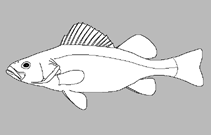
Épines dorsales (Total) : 10 - 11; Rayons mous dorsaux (Total) : 12 - 14; Épines anales: 2; Rayons mous anaux: 7 - 8. Belongs to the subgenus Oligocephalus and most closely related to Etheostoma asprigene. Can be distinguished from other members of the of the subgenus Oligocephalus by having the following characters: spinous dorsal fin base is longer in E. thompsoni than in E. asprigene, E. collettei and E. swaini, averaging >30% of standard length in males and females (<30% in in E. asprigene and other Oligocephalus compared) and the transpelvic width is distinctly narrower than in in E. asprigene, E. collettei and E. swaini; nuptial males of E. thompsoni have significantly shorter snouts and caudal peduncles, and narrower bodies than nuptial males of E. asprigene and other Oligocephalus compared. Nuptial males of E. thompsoni also differ from those of E. asprigene in fin and body coloration by having numerous small red blotches or flecks on the sides of body anterior to the dark blue bars that alternate with bright red bars on posterior part of body and caudal peduncle; the central blue-gray band of the spinous dorsal fin is nearly uniform in width (vs. narrow anteriad and progressively widens posteriad in E. asprigene); lateral areas of the belly and between blue bars on the caudal peduncle is a more intense red-orange than in E. asprigene; lastly, naked nape (vs. fully scaled nape in E. asprigene) (Ref. 93431).
Body shape (shape guide): elongated.
Found invariably along the bank, sometimes under cuts, where there were exposed roots with accumulated vegetational debris, and sand to mixed sand and gravel substrate with very little silt. Forms spawning aggregations and spawns in vegetation along the drop-off area close to shore.
Cycle de vie et comportement reproducteur
Maturité | Reproduction | Frai | Œufs | Fécondité | Larves
Suttkus, R.D., H.L., Bart Jr. and D.A. Etnier, 2012. A new darter of the subgenus Oligocephalus, genus Etheostoma, from southeastern Texas and southwestern Louisiana. Tulane Stud. Zool. Bot. 32:6-30. (Ref. 93431)
Statut dans la liste rouge de l'IUCN (Ref. 130435: Version 2025-2 (Global))
Menace pour l'homme
Harmless
Utilisations par l'homme
Outils
Articles particuliers
Télécharger en XML
Sources Internet
Estimations basées sur des modèles
Indice de diversité phylogénétique (Réf.
82804): PD
50 = 0.5000 [Uniqueness, from 0.5 = low to 2.0 = high].
Bayesian length-weight: a=0.00676 (0.00303 - 0.01510), b=3.12 (2.94 - 3.30), in cm total length, based on LWR estimates for this Genus-body shape (Ref.
93245).
Niveau trophique (Réf.
69278): 3.3 ±0.5 se; based on size and trophs of closest relatives
Résilience (Réf.
120179): Haut, temps minimum de doublement de population inférieur à 15 mois (Preliminary K or Fecundity.).
Vulnérabilité de la pêche (Ref.
59153): Low vulnerability (10 of 100).
🛈