Classification / Noms
Noms communs | Synonymes | Catalog of Fishes(Genre, Espèce) | ITIS | CoL | WoRMS | Cloffa
>
Anabantiformes (Gouramies, snakeheads) >
Osphronemidae (Gouramies) > Macropodusinae
Etymology: Parosphromenus: Greek, para in the side of + Greek, osphromenos, osphrainomai = to smell (Ref. 45335); gunawani: Named for Gunawan ‘Thomas’ Kasim, who, together with Horst Linke and others, collected the type specimens of this species. The name is a masculine singular genitive.
Eponymy: Gunawan ‘Thomas’ Kasim is an Indonesian aquarium fish collector and exporter. Together with Horst Linke and others, he collected the type specimens of this species in Sumatra. (Also see Vera (Kasim)) (Ref. 128868), visit book page.
Environnement : milieu / zone climatique / profondeur / gamme de distribution
Écologie
; eau douce benthopélagique; pH range: 4.1 - ?. Tropical; 29°C - ? (Ref. 93137)
Asia: Jambi, Sumatra in Indonesia.
Taille / Poids / Âge
Maturité: Lm ? range ? - ? cm
Max length : 2.8 cm SL mâle / non sexé; (Ref. 93137)
Description synthétique
Clés d'identification | Morphologie | Morphométrie
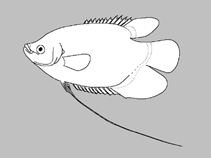
Épines dorsales (Total) : 11 - 13; Rayons mous dorsaux (Total) : 5 - 8; Épines anales: 11 - 12; Rayons mous anaux: 8 - 10. Distinguished by the following unique combination of character states: dorsal fin with 11-13 spines; anal fin with 11-12 spines and 8-10 segmented rays; round caudal fin with narrow bluish vertical band bounded anteriorly by brownish patch and posteriorly by black subdistal band; absence of blotch on posterior part of dorsal fin and reddishbrown bands on anal and dorsal fins (Ref. 93137)
Body shape (shape guide): elongated.
Facultative air-breathing (Ref. 126274); Found in peat swamp associated with a shallow pond (water depth about 30 to 100 cm) and Surface of the swamp was in parts densely covered with aquatic plants (Ref. 93137). Water was shaded by trees and shrubs (Ref. 93137).
Cycle de vie et comportement reproducteur
Maturité | Reproduction | Frai | Œufs | Fécondité | Larves
Schindler, I. and H. Linke, 2012. Two new species of the genus Parosphromenus (Teleostei: Osphronemidae) from Sumatra. Vertebrate Zoology 62(3):399-406. (Ref. 93137)
Statut dans la liste rouge de l'IUCN (Ref. 130435: Version 2025-2 (Global))
Menace pour l'homme
Harmless
Utilisations par l'homme
Outils
Articles particuliers
Télécharger en XML
Sources Internet
Estimations basées sur des modèles
Indice de diversité phylogénétique (Réf.
82804): PD
50 = 0.5000 [Uniqueness, from 0.5 = low to 2.0 = high].
Bayesian length-weight: a=0.00389 (0.00180 - 0.00842), b=3.12 (2.94 - 3.30), in cm total length, based on all LWR estimates for this body shape (Ref.
93245).
Niveau trophique (Réf.
69278): 3.2 ±0.4 se; based on size and trophs of closest relatives
Résilience (Réf.
120179): Haut, temps minimum de doublement de population inférieur à 15 mois (Preliminary K or Fecundity.).
Vulnérabilité de la pêche (Ref.
59153): Low vulnerability (10 of 100).
🛈