分类 / 名称
俗名 | 同种异名 | Catalog of Fishes(属, 种) | ITIS | CoL | WoRMS | Cloffa
Teleostei >
Gymnotiformes (Knifefishes) >
Gymnotidae (Naked-back knifefishes) > Gymnotinae
Etymology: Gymnotus: Greek, gymnos = naked (Ref. 45335); interruptus: From the Latin adjective interruptus, meaning interrupted, due to its pale interbands, anterior to
vertical through first ventral lateral line ramus, ventrally and/or dorsally fragmented (same as interrupted), allowing union of adjacent dark bands.
环境:氛围 / 气候带 / 深度上下限 / 分布范围
生态学
; 淡水 底中水层性.
South America: Riacho Cambiriba, a tributary of the Rio de Contas basin in
northeastern Brazil.
大小 / 重量 / 年龄
成熟度: Lm ? range ? - ? cm
Max length : 12.1 cm TL 雄鱼/尚未辨别雌雄; (Ref. 93136)
简单描述
检索表 | 型态特徵 | 形态测量图
Belongs to the Gymnotus carapo species-group, which is characterized by having a transparent patch near the posterior end of the anal fin and two (vs. one) laterosensory pores in the dorso-posterior region of the preopercle bone. Distinguished by having unique combination of characters: wider interorbital distance (44.6 - 45.9% of STO); 9 scales above lateral line at midbody; 23 - 28 ventrally oriented lateral line rami; 37 - 40 pored lateral line scales to first ventral ramus of lateral line; shorter snout (29.6 - 30.5% of STO). Differs from G. carapo or G. bahianus, two congeners also occurring in northeastern Brazil, by its color pattern in which pale interbands, anterior to vertical through first ventral lateral line ramus, are ventrally and/or dorsally fragmented, allowing union of adjacent dark bands (Ref. 93136).
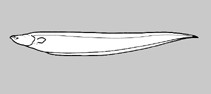
Body shape (shape guide): elongated.
Facultative air-breathing in the genus (Ref. 126274); Occurs in a clear water stream with width of about 4 m, depth of about 1.5 m and bottom composed of sand, gravel and rocks of variable sizes. Found hiding among marginal vegetation and roots. Stomach content of a single specimen consisted of Nematocera larvae, adult Coleoptera and insect eggs (Ref. 93136).
生命周期和交配行为
成熟度 | 繁殖 | 产卵场 | 卵 | 孕卵数 | 仔鱼
Rangel-Pereira, F.d.S., 2012. Gymnotus interruptus, a new species of electric fish from the Rio de Contas basin, Bahia, Brazil (Teleostei: Gymnotiformes: Gymnotidae). Verteb. Zool. 62(3):363-370. (Ref. 93136)
世界自然保护联盟红皮书 (Ref. 130435: Version 2025-2 (Global))
人类利用
渔业: 没有兴趣
工具
特别资料
下载 XML
网络资源
基于模型的估算
系统发育多样性指数 (参考文献
82804): PD
50 = 0.5000 [Uniqueness, from 0.5 = low to 2.0 = high].
Bayesian length-weight: a=0.00437 (0.00209 - 0.00911), b=2.98 (2.79 - 3.17), in cm total length, based on LWR estimates for this (Sub)family-body shape (Ref.
93245).
营养阶层 (参考文献
69278): 3.2 ±0.4 se; based on size and trophs of closest relatives
回复力 (参考文献
120179): 高度, 族群倍增时间少于 15个月 (Preliminary K or Fecundity.).
渔业脆弱性 (Ref.
59153): Low vulnerability (10 of 100).
🛈