Classificatie / Namen
Lokale namen | Synoniemen | Catalog of Fishes(Genus, Soort(en)) | ITIS | CoL | WoRMS | Cloffa
>
Cichliformes (Cichlids, convict blennies) >
Cichlidae (Cichlids) > Cichlasomatinae
Etymology: Laetacara: Latin, laetus = happy + tupí, guaraní acará = a name of a fish (Ref. 45335); flamannellus: Derived from the Latin flammeus, meaning flame colored, and from the Latin annellus, meaning ring, in reference to the orange flame ring around the dorsal-fin spot, one of the diagnostic character states of the new species.
Milieu: milieu / Klimaatzone / Diepte / verspreidingsgebied
Ecologie
; zoet water benthopelagisch. Tropical
South America: coastal floodplains in Brazil.
Grootte / Gewicht / Leeftijd
Maturiteit: Lm ? range ? - ? cm
Max length : 3.8 cm SL mannelijk / geslacht onbekend; (Ref. 91058)
Korte beschrijving
Determinatiesleutels | Morfologie | Morfometrie
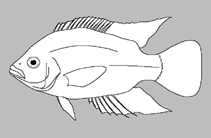
Dorsale stekels (totaal) : 15 - 16; Dorsale zachte stralen (totaal) : 8 - 9; Anale stekels: 3; Anale zachte stralen: 8 - 9; Wervels: 24. Distinguished from all other species of Laetacara by having the following combination of characters: dark brown or black spot located on dorsal-fin base; yellow stripe on the middle portion of the dorsal fin, crossing the whole fin; orange flame ring around the dorsal-fin base spot; no red pigmentation on belly; no red or purple zone on the anal-fin base; no red zone on the caudal-fin base; cycloid scales on the opercle plate; and trunk scales above upper lateral line with few ctenii (Ref. 91058).
Body shape (shape guide): short and / or deep.
Found mainly in in lentic water near the bank, about 1.5 m from the margin in shallow places
(0.3 - 0.5 m) where herbaceous vegetation Cyperaceae prevailed. Other species encountered in the same biotope were Rivulus schuncki Costa & De Luca, 2011, juveniles of Hoplerythrinus unitaeniatus (Spix & Agassiz, 1829) and Nannostomus sp. Also collected from a lotic water creek in a shallow place (0.4 m) on the flooded margin and found sympatric with Apistogramma gossei Kullander, 1982, Crenicichla inpa Ploeg, 1991, Krobia sp., Mesonauta sp., Satanoperca jurupari (Heckel, 1840) and Fluviphylax palikur Costa & Le Bail, 1999 (Ref. 91058).
Levenscyclus en paargedrag
Maturiteit | Voortplanting | Paaien | Eieren | Fecunditeit | Larven
Ottoni, F.P., P.H.N. Bragança, P.F. Amorim and C.S. Gama, 2012. A new species of Laetacara from the northern Brazil coastal floodplains (Teleostei: Cichlidae). Vertebrate Zoology 62(2):181-188. (Ref. 91058)
Status op de Rode Lijst van het IUCN (Ref. 130435: Version 2025-2 (Global))
Gevaar voor de mens
Harmless
Gebruik door de mens
Tools
Speciale rapporten
Download XML
Internetbronnen
Schattingen op basis van modellen
Fylogenetische diversiteitsindex (Ref.
82804): PD
50 = 0.5078 [Uniqueness, from 0.5 = low to 2.0 = high].
Bayesian length-weight: a=0.02692 (0.01211 - 0.05983), b=3.02 (2.83 - 3.21), in cm total length, based on LWR estimates for this (Sub)family-body shape (Ref.
93245).
Trofisch niveau (Ref.
69278): 3.1 ±0.4 se; based on size and trophs of closest relatives
Weerstandsvermogen (Ref.
120179): Hoog, minimale populatieverdubbelingstijd minder dan 15 maanden (Preliminary K or Fecundity.).
Kwetsbaarheid van de visserij (Ref.
59153): Low vulnerability (10 of 100).
🛈