Elasmobranquios (tiburones y rayas) (sharks and rays) >
Carcharhiniformes (Ground sharks) >
Carcharhinidae (Requiem sharks)
Etymology: Carcharhinus: karcharos (Gr.), sharp or jagged; rhinus, an ancient name for sharks, from rhine (Gr.), rasp, both words alluding to a shark's jagged, rasp-like skin (See ETYFish); cerdale: From kerdaleos (Gr.), wary, crafty or fox-like, allusion not explained (but see entries for C. cautus, above, and Alopias, Alopiidae) (See ETYFish).
Entorno: milieu / zona climática / rango de profundidad / gama de distribución
Ecología
marino demersal; rango de profundidad 0 - 40 m (Ref. 106604). Tropical
Eastern Pacific Ocean: from the Gulf of California to Peru.
Tamaño / Peso / Edad
Madurez: Lm ? range ? - ? cm
Max length : 140 cm TL macho / no sexado; (Ref. 86285)
Descripción breve
Claves de identificación | Morfología | Morfometría
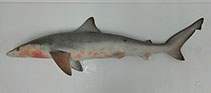
This smooth-backed species is distinguished by the following: some specimens have a very weak interdorsal ridge (evident in embryos and neonates; not noticeable in the holotype or on a 103.4-cm male individual); first dorsal fin originates about the middle of the pectoral fin inner margin; its anterior margin is much longer than the distance from the apex to the free rear tip; height of first dorsal fin is about 9-10.5% of TL; second dorsal fin originates over or behind middle of anal base; caudal fin measures about one-fourth of the total length; has minute, inconspicuous hyomandibular pores behind the eye; upper teeth, from the first to the fifth tooth have broadly triangular, increasingly oblique cusps with serrated edges, with a notch on both edges at about a third of length from the base to the cusp (serrations from the notch to the base are much larger than those on the rest of the cusp); lower teeth have narrow, erect to slightly oblique, triangular cusps with more finely serrated edges; teeth number U:13 to 15-1 or 2-13 to 15, L:12 to 15-0 to 2-12 to 15; denticles roughly oblong and have minimal overlapping, with three central ridges, the central ridge being only slightly longer than the side ridges and terminating in a slightly longer point. Colour in preserved specimens: the first and second dorsal fins, the pelvic fins and the anal fin had dark or dusky edges, and the pectoral fins usually had dusky or black tips on their dorsal sides, and the lower caudal lobe was dusky or blacktipped; neonates have caudal fins with a black border, and their pectoral fins have a wide, white rear margin (Ref. 86285).
Body shape (shape guide): fusiform / normal.
Ciclo vital y comportamiento de apareamiento
Madurez | Reproducción | Puesta | Huevos | Fecundidad | Larva
Castro, J.I., 2011. Resurrection of the name Carcharhinus cerdale, a species different from Carcharhinus porosus. aqua, International Journal 17(1):1-10. (Ref. 86285)
Situación en la Lista Roja de la UICN (Ref. 130435: Version 2025-2 (Global))
Amenaza para el ser humano
Harmless
Usos humanos
Herramientas
Informes especiales
Descargar XML
Fuentes de Internet
Estimaciones basadas en modelos
Índice de diversidad filogenética (Referencia
82804): PD
50 = 0.5000 [Uniqueness, from 0.5 = low to 2.0 = high].
Bayesian length-weight: a=0.00525 (0.00244 - 0.01130), b=3.07 (2.90 - 3.24), in cm total length, based on LWR estimates for this Genus-body shape (Ref.
93245).
Nivel trófico (Referencia
69278): 4.1 ±0.6 se; based on size and trophs of closest relatives
Resiliencia (Referencia
120179): Bajo, población duplicada en un tiempo mínimo de 4.5-14 años (Preliminary low fecundity).
Vulnerabilidad pesquera (Ref.
59153): Very high vulnerability (84 of 100).
🛈