>
Characiformes (Characins) >
Hepsetidae (African pikes)
Etymology: Hepsetus: Greek, epsetas, -e, -on = boiled, but there is the following sentence: "oí epsetoi" = certain fishes, and also could be related to "psetta" = grouper (Ref. 45335); kingsleyae: Dedicated to the British explorer Mary Kingsley (1862–1900), who collected several species of fishes in the area, including a few specimens of Hepsetus, as part of her commitment to A. Günther of the British Museum of Natural History (BMNH, London)(Ref. 93279).
Eponymy: Mary Henrietta Kingsley (1862–1900) was an ethnographic and scientific writer and explorer. [...] (Ref. 128868), visit book page.
Entorno: milieu / zona climática / rango de profundidad / gama de distribución
Ecología
; agua dulce pelágico. Tropical; 0°S - 1°S, 9°E - 11°E
Africa: endemic to the Ogowe River basin in Gabon; known from lakes in contact with the Ogowe main channel, or in rivers close to the lakes; not recorded from the Ngounié (Ref. 93279).
Tamaño / Peso / Edad
Madurez: Lm ? range ? - ? cm
Max length : 22.0 cm SL macho / no sexado; (Ref. 93279)
Descripción breve
Claves de identificación | Morfología | Morfometría
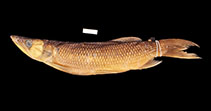
Diagnosis: distinguished from H. akawo and H. lineata by a narrower head width [26.4–35.6 (mean 33.1) v. 32.8–42.3 (37.0) and 32.8–46.7 (39.4)%HL, respectively] and its narrower internasal distance [15.6–23.3 (mean 20.6) v. 21.9–28.3 (24.7) and 21.5–29.3 (25.1)%HL, respectively]; both characters are positively allometric; distinguished from H. lineata by smaller number of lateral-line scales (45–51 v. 50–64) and higher number of gill rakers [17–23 v. 12–18 (exceptionally 20 in 1 specimen)]; distinguished from H. odoe by smaller number of lateral-line scales [45–51 v. 51–60 (exceptionally 49)] and smaller distance between nostril and lower jaw [33.2–40.9 (mean 38.2) v. 40.4–47.6 (43.1)%HL]; latter character is positively allometric; distinguished from H. cuvieri by higher number of gill rakers (17–23 v. 8–13), lower number of scales between dorsal fin and lateral line (8.5–9.5 v.10.5–11.5), lower number of scales between adipose fin and lateral line (5.5 v. 6.5–7.5) and longer snout [39.3–43.2 (mean 41.0) v. 35.5–38.8 (37.3)%HL]; latter character is positively allometric (Ref. 93279).
Body shape (shape guide): elongated.
Ciclo vital y comportamiento de apareamiento
Madurez | Reproducción | Puesta | Huevos | Fecundidad | Larva
Decru, E., E. Vreven and J. Snoeks, 2013. A revision of the Lower Guinean Hepsetus species (Characiformes; Hepsetidae) with the description of Hepsetus kingsleyae sp. nov. J. Fish Biol. 82(4):1351-1375. (Ref. 93279)
Situación en la Lista Roja de la UICN (Ref. 130435: Version 2025-2 (Global))
Amenaza para el ser humano
Harmless
Usos humanos
Herramientas
Informes especiales
Descargar XML
Fuentes de Internet
Estimaciones basadas en modelos
Índice de diversidad filogenética (Referencia
82804): PD
50 = 0.5312 [Uniqueness, from 0.5 = low to 2.0 = high].
Bayesian length-weight: a=0.00479 (0.00201 - 0.01138), b=3.17 (2.96 - 3.38), in cm total length, based on LWR estimates for this (Sub)family-body shape (Ref.
93245).
Nivel trófico (Referencia
69278): 3.0 ±0.4 se; based on size and trophs of closest relatives
Resiliencia (Referencia
120179): Alto, población duplicada en un tiempo mínimo inferior a 15 meses (Preliminary K or Fecundity.).
Vulnerabilidad pesquera (Ref.
59153): Low vulnerability (17 of 100).
🛈
Nutrientes (Ref.
124155): Calcium = 184 [75, 446] mg/100g; Iron = 2.27 [1.12, 5.25] mg/100g; Protein = 18.4 [16.3, 20.7] %; Omega3 = 0.371 [0.145, 0.945] g/100g; Selenium = 63 [24, 215] μg/100g; VitaminA = 33.9 [12.3, 90.2] μg/100g; Zinc = 2.32 [1.62, 3.40] mg/100g (wet weight);