Clasificación / Nombres
Nombres comunes | Sinónimos | Catalog of Fishes(Género, Especie) | ITIS | CoL | WoRMS | Cloffa
>
Cichliformes (Cichlids, convict blennies) >
Cichlidae (Cichlids) > Cichlinae
Etymology: Crenicichla: Latin, crenulatus = cut, clipped + Greek, kichle = wrasse (Ref. 45335); gillmorlisi: Named for ichthyologist Walter A. Gill Morlis A., fisheries officer of the Itaipú Binacional, Ciudad del Este, Paraguay, who contributed considerably to the PROVEPA surveys of fishes in tributaries of the Paraná River, and in special recognition of his strong long term engagement in the inventory of the fishes of the río Paraná.
Eponymy: Walter A Gill Morlis is a Paraguayan ichthyologist who is a fisheries officer of the Itaipú Binacional, Ciudad del Este, Paraguay. [...] (Ref. 128868), visit book page.
Entorno: milieu / zona climática / rango de profundidad / gama de distribución
Ecología
; agua dulce bentopelágico; rango de profundidad 1 - 2 m (Ref. 93325). Tropical
South America: Río Acaray drainage in Paraguay.
Tamaño / Peso / Edad
Madurez: Lm ? range ? - ? cm
Max length : 17.4 cm SL macho / no sexado; (Ref. 93325)
Descripción breve
Claves de identificación | Morfología | Morfometría
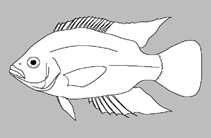
Espinas dorsales (total) : 19 - 22; Radios blandos dorsales (total) : 11 - 12; Espinas anales: 3; Radios blandos anales: 7 - 9; Vértebra: 35 - 37. Distinguished from all congeners by the color pattern which develops as a row of paired vertical bars in young, and which are further fragmented into an adult color pattern composed of small dark spots all over the sides. Other characters useful to diagnose from other species include the following: 42-57 E1 scales; smooth supracleithrum; absence of a humeral blotch; infraorbitals 3 and 4 separate; cycloid cheek and predorsal scales; movable implanted outer teeth; nostril well separated from upper lip; serrated preopercular margin; lower jaw prognathous; preopercular margin serrated; preopercle serrated; black dots marking lateral line scales absent. Most similar to C. mandelburgeri in proportional measurements and meristics, but distinguished by the dissolution of vertical bars into small spots, absent in C. mandelburgeri (Ref. 93325).
Body shape (shape guide): short and / or deep.
Specimens composed of an adult and 2 young were collected from a small stream with brownish very turbid water, with moderate current, about 4 m wide and 1-1.5 m deep. The bottom substrate was composed of rocks and stones. Fishes were encountered along overhanging banks. Associated species included Gymnogeophagus setequedas Reis, Malabarba & Pavanelli (Cichlidae) and Bryconamericus stramineus Eigenmann (Characidae), Astyanax sp. (Characidae), Hypostomus dlouhyi Weber, Hypoptopoma sp. (Loricariidae), Hoplias sp. (Erythrinidae), Leporinus lacustris Amaral Campos (Anostomidae), Steindachnerina brevipinnis (Eigenmann & Eigenmann) (Curimatidae), Eigenmannia virescens (Valenciennes) (Sternopygidae), Crenicichla lepidota (Cichlidae), and Pyrrhulina australis Eigenmann & Kennedy (Lebiasinidae). A juvenile was also captured in a small stream, more than 1.5 m deep with running, dark and turbid water and bottom consisted of sand, in open landscape with low trees and grass. Associated species with this juvenile were Characidium sp. (Crenuchidae) and Bryconamericus stramineus (Characidae), Astyanax sp., Cheirodon sp., Hemigrammus sp., Mimagoniates microlepis (Steindachner) (Characidae), Corydoras diphyes Axenrot & Kullander (Callichthyidae), Bunocephalus sp. (Aspredinidae), Gymnogeophagus setequedas (Cichlidae), Hypoptopoma sp., (Loricariidae), and Phallotorynus victoriae Oliveros (Poeciliidae) (Ref. 93325).
Ciclo vital y comportamiento de apareamiento
Madurez | Reproducción | Puesta | Huevos | Fecundidad | Larva
Kullander, S.O. and C.A.S. Lucena, 2013. Crenicichla gillmorlisi, a new species of cichlid fish (Teleostei: Cichlidae) from the Paraná river drainage in Paraguay. Zootaxa 3641(2):149-164. (Ref. 93325)
Situación en la Lista Roja de la UICN (Ref. 130435: Version 2025-2 (Global))
Amenaza para el ser humano
Harmless
Usos humanos
Herramientas
Informes especiales
Descargar XML
Fuentes de Internet
Estimaciones basadas en modelos
Índice de diversidad filogenética (Referencia
82804): PD
50 = 0.5000 [Uniqueness, from 0.5 = low to 2.0 = high].
Bayesian length-weight: a=0.03020 (0.01328 - 0.06866), b=3.03 (2.84 - 3.22), in cm total length, based on LWR estimates for this (Sub)family-body shape (Ref.
93245).
Nivel trófico (Referencia
69278): 3.3 ±0.5 se; based on size and trophs of closest relatives
Resiliencia (Referencia
120179): Alto, población duplicada en un tiempo mínimo inferior a 15 meses (Preliminary K or Fecundity.).
Vulnerabilidad pesquera (Ref.
59153): Low vulnerability (11 of 100).
🛈