Klassifizierung / Names
Namen | Synonyme | Catalog of Fishes(Gattung, Arten) | ITIS | CoL | WoRMS | Cloffa
>
Cypriniformes (Carps) >
Danionidae (Danios) > Chedrinae
Etymology: Thryssocypris: Greek, thrissa, -es = shad + Greek, Kypris, other name for Aphrodite, proceeding from Cyprus (Kypris), Greek, kyprinos = carp (Ref. 45335); wongrati: Named for Dr. Prachit Wongrat.
Eponymy: Dr Prachit Wongrat of the Faculty of Fishes, Kasetsart University, Bangkok is a fish taxonomist. [...] (Ref. 128868), visit book page.
Umwelt: Milieu / Klimazone / Tiefenbereich / Verbreitungsgebiet
Ökologie
; süßwasser benthopelagisch. Tropical
Asia: Chao Phraya basin, Thailand.
Größe / Gewicht / Alter
Geschlechtsreife: Lm ? range ? - ? cm
Max length : 5.2 cm SL Männchen/unbestimmt; (Ref. 93051)
Kurzbeschreibung
Bestimmungsschlüssel | Morphologie | Morphometrie
Rückenflossenweichstrahlen (insgesamt) : 9 - 10; Afterflossenweichstrahlen: 14 - 16; Wirbelzahl: 39 - 41. Diagnosed from all congeners by having the origin of the dorsal fin behind the origin of the anal fin, 37-40 lateral-line scales, 16 circumpeduncular scales, and a dark spot at the base of the caudal fin. Differs from Thryssocypris smaragdinus in having the origin of the dorsal fin behind (vs. over or in front of) the origin of the anal fin and 16 (vs. 15) circumpeduncular scales, and from T. tonlesapensis and T. ornithosoma in having 37-40 (vs. 42-46) lateral-line scales and 39-41 (vs. 43-45) vertebrae. Can be further separated from T. ornithosoma by having a dark spot at the base of the caudal fin (Ref. 93051).
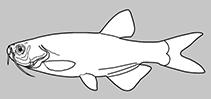
Body shape (shape guide): elongated.
Collected mostly by large seines with small mesh measuring 2 mm from open water in the Chao Phraya River mainstem. Also found in current in irrigation canals. Observed to form school at the surface of the water, swimming very fast with other species such as Clupeoides borneensis, Rasbora spp., Barilius koratensis, Paralaubuca spp. and Discherodontus halei (Ref. 93051).
Lebenszyklus und Paarungsverhalten
Geschlechtsreife | Fortpflanzung | Ablaichen | Eier | Fruchtbarkeit | Larven
Grudpan, C. and J. Grudpan, 2012. Thryssocypris wongrati, a new anchovy-like cyprinid (Cypriniformes) from the Chao Phraya basin, Thailand. Zootaxa 3586:228-235. (Ref. 93051)
IUCN Rote Liste Status (Ref. 130435: Version 2025-2 (Global))
Bedrohung für Menschen
Harmless
Nutzung durch Menschen
Tools
Zusatzinformationen
Download XML
Internet Quellen
Schätzungen auf der Grundlage von Modellen
Phylogenetischer Diversitätsindex (Ref.
82804): PD
50 = 0.5625 [Uniqueness, from 0.5 = low to 2.0 = high].
Bayesian length-weight: a=0.00589 (0.00280 - 0.01240), b=3.00 (2.82 - 3.18), in cm total length, based on LWR estimates for this (Sub)family-body shape (Ref.
93245).
Trophische Ebene (Ref.
69278): 3.2 ±0.4 se; based on size and trophs of closest relatives
Widerstandsfähigkeit (Ref.
120179): hoch, Verdopplung der Population dauert weniger als 15 Monate. (Preliminary K or Fecundity.).
Anfälligkeit der Fischerei (Ref.
59153): Low vulnerability (10 of 100).
🛈