Elasmobranchii (hajar och rockor) (sharks and rays) >
Squaliformes (Sleeper and dogfish sharks) >
Dalatiidae (Sleeper sharks)
Etymology: Dalatias: Etymology not explained nor evident. A few online sources suggest Dalatias is derived from dalos (Gr.), torch or firebrand, but nothing in Rafinesque’s description supports this interpretation. Interestingly, D. licha is bioluminescent, a fact that was discovered and resported only recently and was certainly unknown to Rafinesque and other early naturalists. See: Mallefet J., D. W. Stevens, and L. Duchatelet. 2021. Bioluminescence of the largest luminous vertebrate, the kitefin shark, Dalatias licha: first insights and comparative aspects. Frontiers in Marine Science 8 (article 633582): 1-13 (See ETYFish); licha: Latinization of “La Liche” as reported by Broussonet (1780), an old French word for this shark, possibly from from the Occitan lecha or lec, meaning “glutton” (See ETYFish).
More on author: Bonnaterre.
Miljö: miljö / Klimatzon / djupintervall / distributionsområde
Ekologi
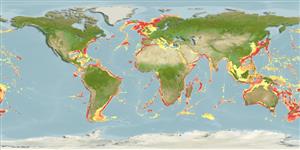
marina djupbottenlevande; djupintervall 37 - 1800 m (Ref. 247), usually 300 - 600 m (Ref. 247). Deep-water; 72°N - 56°S, 98°W - 153°W
Circumglobal: Atlantic, Pacific, Indian Ocean and the Mediterranean.
Längd vid första mognad / Storlek / Vikt / Ålder
Könsmognad: Lm 139.0, range 117 - 159 cm
Max length : 182 cm TL hane/ej könsbestämd; (Ref. 10717)
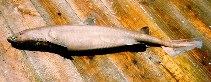
Taggstrålar i ryggfenan (totalt) : 0; Taggstrålar i analfenan: 0. Moderately sized, short- and blunt-snouted shark with two almost equal-sized dorsal fins; papillose thick lips; small slender-cusped upper teeth and very large lower teeth with erect triangular serrated cusps and distal blades; first dorsal fin on back with its origin behind the pectoral rear tips and its base closer to the pectoral base than the pelvic fins; and caudal fin with the ventral lobe not expanded (Ref. 247). Dark grey-brown to black; trailing edges of fins translucent (Ref. 26346).
Body shape (shape guide): elongated.
Found on outer continental and insular shelves and slopes (Ref. 247). Mainly found on or near the bottom but readily occurs well off the substrate (Ref. 247, 58302). Often pelagic (Ref. 58302). Found singly or in small schools (Ref. 6871). Feeds mainly on deepwater bony fish, but also skates, other sharks (etmopterids in Ref. 123656), cephalopods and crustaceans (Ref. 5578). This bioluminescent shark (currently the largest luminous vertebrate) emit light ventrally to counterilluminate which might be used to illuminate the ocean floor while searching/hunting for prey; or to stealthily approach prey, using counterillumination camouflage, before striking fast when it is close enough (Ref. 123656). Ovoviviparous (Ref. 205), with 10-20 young born at 30-42 cm (Ref. 26346). Used for its squalene liver oil, leather and meat, as well as for fishmeal (Ref. 6871).
Ovoviviparous (Ref. 247). 10-20 young born at 30-42 cm (Ref. 26346); 10-16 young born at 30 cm TL (Ref.58048). Distinct pairing with embrace (Ref. 205).
Compagno, L.J.V., 1984. FAO Species Catalogue. Vol. 4. Sharks of the world. An annotated and illustrated catalogue of shark species known to date. Part 1 - Hexanchiformes to Lamniformes. FAO Fish. Synop. 125(4/1):1-249. Rome, FAO. (Ref. 247)
Status på IUCN:s rödlista (Ref. 130435: Version 2025-2 (Global))
Hot mot människor
Harmless
Mänskliga användningsområden
Fiskeri: mindre kommeriell
Verktyg
Särskilda rapporter
Ladda ner XML
Internet-källor
Uppskattningar baserade på modeller
Önskad temperatur (Ref.
123201): 2.5 - 14.3, mean 5.3 °C (based on 3093 cells).
Index för fylogenetisk mångfald (Ref.
82804): PD
50 = 1.0010 [Uniqueness, from 0.5 = low to 2.0 = high].
Bayesian length-weight: a=0.00240 (0.00181 - 0.00319), b=3.14 (3.06 - 3.22), in cm total length, based on LWR estimates for this species (Ref.
93245).
Trofisk nivå (Ref.
69278): 4.2 ±0.4 se; based on diet studies.
Resiliens (Ref.
120179): Låg, lägsta populationsfördubblingstid 4,5-14 år (Fec=10-20).
Prior r = 0.27, 95% CL = 0.18 - 0.40, Based on 1 data-limited stock assessment.
Sårbarhet i fisket (Ref.
59153): High to very high vulnerability (65 of 100).
🛈
Sårbarhet för klimatet (Ref.
125649): Moderate vulnerability (38 of 100).
🛈
Näringsämnen (Ref.
124155): Calcium = 6.01 [1.29, 31.29] mg/100g; Iron = 0.325 [0.075, 1.053] mg/100g; Protein = 19.3 [17.4, 21.2] %; Omega3 = 0.303 [0.107, 0.998] g/100g; Selenium = 21.6 [5.9, 65.2] μg/100g; VitaminA = 6.5 [1.4, 30.4] μg/100g; Zinc = 0.214 [0.104, 0.400] mg/100g (wet weight);