Classificazione / Nomi
Nomi Comuni | Sinonimi | Catalog of Fishes(Genere, Specie) | ITIS | CoL | WoRMS | Cloffa
>
Siluriformes (Catfishes) >
Loricariidae (Armored catfishes) > Hypostominae
Etymology: Hypostomus: Greek, hypo = under + Greek, stoma = mouth (Ref. 45335); arecuta: Named from a Guaraní word arecutá, meaning loricariid fish.
Ambiente: milieu / zona climatica / distribuzione batimetrica / gamma di distribuzione
Ecologia
; acqua dolce demersale; pH range: 6.8 - 7.1. Subtropical
South America: Paraná river in Argentina.
Dimensione / Peso / Età
Maturità: Lm ? range ? - ? cm
Max length : 24.3 cm SL maschio/sesso non determinato; (Ref. 91776)
Breve descrizione
Chiavi di identificazione | Morfologia | Morfometria
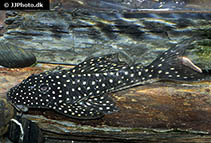
Spine dorsali (totale) : 2; Raggi dorsali molli (totale) : 7; Spine anali: 1; Raggi anali molli: 4. Differs from its congeners by the following combination of characters: dorsum of head and body and all fins dark grey covered by numerous rounded cream dots; ventral surface of head and belly a plain cream color; 66-85 premaxillary/dentary teeth; cleithral width 3.0-3.4 in SL; abdominal length 3.9-4.5 in SL; eye diameter 5.2-6.2 in HL; pelvic fin-spine length 3.9-4.5 in SL; caudal peduncle depth 8.3-9.6 in SL; upper caudal-ray length 2.8-3.6 in SL; lower caudal-ray length 2.4-3.5 in SL; right mandibular ramus 3.9-4.6 in HL; dorsal spine length with mean 31.6 % SL; length of right mandibular ramus 3.9-4.6 in HL; abdominal length 3.9-4.5 in SL; head depth 1.6-1.7 in HL;, interorbital width 2.6-3.0 in HL; predorsal length 2.3-2.6 in SL; pectoral-fin spine length 2.8-3.3 in SL; caudal peduncle length 3.0-3.6 in SL; scutes along lateral line 26-28 (mode 27); scutes between end of dorsal fin to adipose fin 5-6 (mode 6) ; scutes from adipose to caudal fins 3-5 (mode 5), and scutes from anal to caudal fins 12-14 (mode 14) (Ref. 91776).
Body shape (shape guide): elongated.
Facultative air-breathing in the genus (Ref. 126274); Found in coastal areas of main river channel with bottom composed mostly by large boulders of sandstone with patches of sand and pebbles. Occurs in well oxygenated waters having moderate current speed, about 0.60 m s-1, water transparency of 1.5-2.40 m and conductivity of 50.9-59.6 μS cm-1 . Sympatric with Hypostomus commersoni, H. cochliodon,, H. uruguayensis, H. latifrons, H. ternetzi, H. luteomaculatus, H. microstomus, and H. boulengeri (Ref. 91776).
Ciclo vitale e comportamento di accoppiamento
Maturità | Riproduzione | Deposizione | Uova | Fecondità | Larve
Cardoso, Y.P., A. Almirón, J. Casciotta, D. Aichino, M.S. Lizarralde and J.I. Montoya-Burgos, 2012. Origin of species diversity in the catfish genus Hypostomus (Siluriformes: Loricariidae) inhabiting the Paraná river basin, with the description of a new species. Zootaxa 3453:69-83. (Ref. 91776)
Stato della Lista Rossa IUCN (Ref. 130435: Version 2025-2 (Global))
Minaccia per l'uomo
Harmless
Usi umani
Pesca: di nessun interesse
Strumenti
Rapporti speciali
Scarica XML
Fonti Internet
Stime basate su modelli
Indice di diversità filogenetica (Fonte Biblio.
82804): PD
50 = 0.5000 [Uniqueness, from 0.5 = low to 2.0 = high].
Bayesian length-weight: a=0.01585 (0.00726 - 0.03460), b=2.95 (2.78 - 3.12), in cm total length, based on LWR estimates for this Genus-body shape (Ref.
93245).
Resilienza (Fonte Biblio.
120179): Medio, tempo minimo di raddoppiamento della popolazione 1.4 - 4.4 anni (Preliminary K or Fecundity.).
Vulnerabilità della pesca (Ref.
59153): Low vulnerability (20 of 100).
🛈