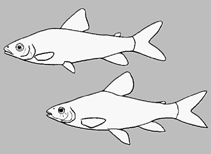
Classificazione / Nomi
Nomi Comuni | Sinonimi | Catalog of Fishes(Genere, Specie) | ITIS | CoL | WoRMS | Cloffa
>
Characiformes (Characins) >
Anostomidae (Headstanders)
Etymology: Leporinus: Latin, lepus, leporis = rabbit (Ref. 45335); santosi: Named for Geraldo Mendes dos Santos, a researcher from INPA, for his important contributions to our knowledge of the fish fauna of the lower rio Tocantins, through his studies on the species of Anostomidae (Santos & Jégu, 1989), and on the impacts of the Tucuruí dam (Santos et al., 1984; Santos et al., 2004). An noun.
Eponymy: Dr Geraldo Mendes dos Santos is a Brazilian aquatic biologist and philosopher. [...] (Ref. 128868), visit book page.
Ambiente: milieu / zona climatica / distribuzione batimetrica / gamma di distribuzione
Ecologia
; acqua dolce benthopelagico. Tropical
South America: lower rio Tocantins in Pará State, Brazil.
Dimensione / Peso / Età
Maturità: Lm ? range ? - ? cm
Max length : 13.5 cm SL maschio/sesso non determinato; (Ref. 93223)
Breve descrizione
Chiavi di identificazione | Morfologia | Morfometria
Raggi dorsali molli (totale) : 12; Raggi anali molli: 10; Vertebre: 33. Can be diagnosed from all other species of Leporinus , except L. gomes i, L. granti , and L. nijssen i, by the presence of three prominent dark midlateral blotches, smaller blotches formed by dermal pigment, five of which form an interrupted "X" between head and first midlateral blotch, small dark spots formed by epidermal pigment, terminal mouth with four teeth on premaxilla and four on dentary, and relatively few scales on lateral line (less than 36). Differs further from all congeners, except L. gomesi , by having a conspicuous dark spots on the center of scales on anterolateral portion of the body; from L. gomesi by having 16 (vs. 12) scale rows around the caudal peduncle, and the second midlateral dark blotch rounded and not extended posteriorly to the vertical through the posterior margin of the adipose fin (vs. second midlateral dark blotch elongate, extended posteriorly to the vertical through the posterior margin of the adipose fin) (Ref. 93223).
Ciclo vitale e comportamento di accoppiamento
Maturità | Riproduzione | Deposizione | Uova | Fecondità | Larve
Distinct pairs breed on densely grown weedy places (Ref. 205).
Britski, H.A. and J.L.O. Birindelli, 2013. A new species of Leporinus Agassiz, 1829 (Characiformes: Anostomidae) from the rio Tocantins, Brazil. Neotrop. Ichthyol. 11(1):25-32. (Ref. 93223)
Stato della Lista Rossa IUCN (Ref. 130435: Version 2025-2 (Global))
Minaccia per l'uomo
Harmless
Usi umani
Strumenti
Rapporti speciali
Scarica XML
Fonti Internet
Stime basate su modelli
Indice di diversità filogenetica (Fonte Biblio.
82804): PD
50 = 0.5000 [Uniqueness, from 0.5 = low to 2.0 = high].
Bayesian length-weight: a=0.01023 (0.00469 - 0.02234), b=3.04 (2.86 - 3.22), in cm total length, based on LWR estimates for this Genus-body shape (Ref.
93245).
Livello trofico (Fonte Biblio.
69278): 2.5 ±0.1 se; based on size and trophs of closest relatives
Resilienza (Fonte Biblio.
120179): Alto, tempo minimo di raddoppiamento della popolazione meno di 15 mesi (Preliminary K or Fecundity.).
Vulnerabilità della pesca (Ref.
59153): Low vulnerability (10 of 100).
🛈