>
Characiformes (Characins) >
Acestrorhamphidae (American tetras) > Hyphessobryconinae
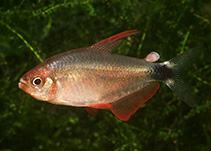
Etymology: Hyphessobrycon: Greek, hyphesson, -on, -on = a little smaller + Greek, bryko = to bite (Ref. 45335); peugeoti: The specific name is patronymic to the Peugeot family, who invented the Peugeot pepper mill mechanism in 1842 and whose manufacturing business led to the establishment of a carbon sink reforestation project in the fazenda São Nicolau, in central Brazil, and eventually to the discovery of this new species.
Eponymy: The fish is named for a family rather than an individual: the Peugeot family (best known now for their cars) invented the Peugeot pepper mill mechanism (1842) and their manufacturing business led to the establishment of a carbon sink reforestation [...] (Ref. 128868), visit book page.
Milieu: milieu / Klimaatzone / Diepte / verspreidingsgebied
Ecologie
; zoet water benthopelagisch. Tropical
South America: Brazil.
Grootte / Gewicht / Leeftijd
Maturiteit: Lm ? range ? - ? cm
Max length : 3.2 cm SL mannelijk / geslacht onbekend; (Ref. 93222)
Korte beschrijving
Determinatiesleutels | Morfologie | Morfometrie
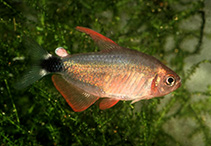
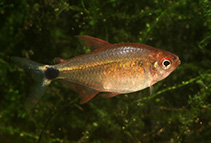
Dorsale zachte stralen (totaal) : 9; Anale zachte stralen: 19 - 24. This species is distinguished from all congeners, except with H. elachys, H. heliacus, H. loweae, by having a conspicuously elongated and filamentous dorsal fin in mature males (vs. dorsal and pelvic fins, when elongated, never filamentous), by its overall red color when alive (vs. a general clear/silvery color in elachys and golden color in heliacus, loweae); further differs from elachys by having a straight margin of anal fin in mature males (vs. a distinctly rounded anal-fin lobe elachys ); differs from heliacus by having a shorter pelvic-fins in fully mature males, reaching only the second anal-fin branched ray (vs. pelvic-fins filamentous, reaching to the sixth anal-fin branched ray) and by lacking chevron-like dark markings along the midline (vs. chevron-like dark markings along the midline present); differs from loweae by having a lower number of horizontal scale rows between the dorsal-fin origin and the lateral line 5 (vs.6-7) and by the higher number of branched anal-fin rays 21-24, modally 22 (vs. 17-21, modally 20) (Ref. 93222).
Body shape (shape guide): elongated; Cross section: compressed.
Levenscyclus en paargedrag
Maturiteit | Voortplanting | Paaien | Eieren | Fecunditeit | Larven
Ingenito, L.F.S., F.C.T. Lima and P.A. Buckup, 2013. A new species of Hyphessobrycon Durbin (Characiformes: Characidae) from the rio Juruena basin, Central Brazil, with notes on H. loweae Costa & Géry. Neotrop. Ichthyol. 11(1):33-44. (Ref. 93222)
Status op de Rode Lijst van het IUCN (Ref. 130435: Version 2025-2 (Global))
Gevaar voor de mens
Harmless
Gebruik door de mens
Tools
Speciale rapporten
Download XML
Internetbronnen
Schattingen op basis van modellen
Fylogenetische diversiteitsindex (Ref.
82804): PD
50 = 0.5000 [Uniqueness, from 0.5 = low to 2.0 = high].
Bayesian length-weight: a=0.00676 (0.00269 - 0.01698), b=3.12 (2.90 - 3.34), in cm total length, based on LWR estimates for this (Sub)family-body shape (Ref.
93245).
Trofisch niveau (Ref.
69278): 2.9 ±0.3 se; based on size and trophs of closest relatives
Weerstandsvermogen (Ref.
120179): Hoog, minimale populatieverdubbelingstijd minder dan 15 maanden (Preliminary K or Fecundity.).
Kwetsbaarheid van de visserij (Ref.
59153): Low vulnerability (10 of 100).
🛈