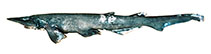
Elasmobranchi (squali e razze) (sharks and rays) >
Carcharhiniformes (Ground sharks) >
Pentanchidae (Deepwater catsharks)
Etymology: Apristurus: a-, Latin privative, i.e., without; pristis, from pristes (Gr.), sawyer (but here meaning saw); oura (Gr.), tail, referring to absence of saw-toothed crest of enlarged dermal denticles along upper edge of caudal fin as found in the closely related Pristiurus (=Galeus) (See ETYFish); nakayai: In honor of ichthyologist Kazuhiro Nakaya (b. 1945), Hokkaido University (Japan), who has dedicated his research on Apristurus, describing eight new species and revising the genus in 2009 (See ETYFish).
Eponymy: Dr Kazuhiro Nakaya (d: 1945) is a Japanese ichthyologist and marine scientist who specialises in the taxonomy and evolution of sharks and rays, and also the fish of Lake Tanganyika. [...] (Ref. 128868), visit book page.
Ambiente: milieu / zona climatica / distribuzione batimetrica / gamma di distribuzione
Ecologia
marino batipelagico; distribuzione batimetrica 953 - 1022 m (Ref. 93246). Deep-water; 21°S - 22°S, 157°E - 158°E (Ref. 93246)
Pacific Ocean: New Caledonia.
Dimensione / Peso / Età
Maturità: Lm ? range ? - ? cm
Max length : 67.6 cm TL maschio/sesso non determinato; (Ref. 93246)
Breve descrizione
Chiavi di identificazione | Morfologia | Morfometria
A medium-sized species of Apristurus of the brunneus group with the following combination of characters: shiny white iris on fresh specimen; brownish black colouration; short interspace from P1 free rear tip to P2 origin, subequal to internarial width; midpoint of the total length located well behind cloaca; pectoral fins large, width about 2.7 times P1 tip-P2 origin; long anal-fin base, longer than D1 insertion-D2 insertions; first dorsal fin located well behind pelvic-fin insertion; first dorsal fin markedly smaller than second one; long caudal fin terminal lobe, its length more than twice its height; no denticles in the mouth; very short pyloric stomach; intestinal spiral valves 16; monospondylous vertebrae 36; precaudal diplospondylous vertebrae 37 (Ref. 92346).
Body shape (shape guide): elongated.
Ciclo vitale e comportamento di accoppiamento
Maturità | Riproduzione | Deposizione | Uova | Fecondità | Larve
Iglésias, S.P., 2012. Apristurus nakayai sp. nov., a new species of deepwater catshark (Chondrichthyes: Pentanchidae) from New Caledonia. Cybium 36(4):511-519. (Ref. 93246)
Stato della Lista Rossa IUCN (Ref. 130435: Version 2025-2 (Global))
Minaccia per l'uomo
Harmless
Usi umani
Strumenti
Rapporti speciali
Scarica XML
Fonti Internet
Stime basate su modelli
Indice di diversità filogenetica (Fonte Biblio.
82804): PD
50 = 0.5000 [Uniqueness, from 0.5 = low to 2.0 = high].
Bayesian length-weight: a=0.00347 (0.00172 - 0.00698), b=3.08 (2.90 - 3.26), in cm total length, based on LWR estimates for this (Sub)family-body shape (Ref.
93245).
Livello trofico (Fonte Biblio.
69278): 4.0 ±0.6 se; based on size and trophs of closest relatives
Resilienza (Fonte Biblio.
120179): Medio, tempo minimo di raddoppiamento della popolazione 1.4 - 4.4 anni (Preliminary K or Fecundity.).
Vulnerabilità della pesca (Ref.
59153): Moderate to high vulnerability (47 of 100).
🛈