Classification / Noms
Noms communs | Synonymes | Catalog of Fishes(Genre, Espèce) | ITIS | CoL | WoRMS | Cloffa
>
Cyprinodontiformes (Rivulines, killifishes and live bearers) >
Rivulidae (Rivulines) > Cynolebiinae
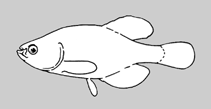
Etymology: pterophyllus: Name derived from the Greek pteron (wing) and phyllon (leaf), referring to long dorsal and anal fins in males, also an allusion to the superficial similarity with Pterophyllum scalare Lichtenstein, an Amazonian cichlid fish with long dorsal and anal and dark bars on body sides.
Environnement : milieu / zone climatique / profondeur / gamme de distribution
Écologie
; eau douce benthopélagique. Tropical
South America: São Francisco River basin, Brazil.
Taille / Poids / Âge
Maturité: Lm ? range ? - ? cm
Max length : 6.5 cm SL mâle / non sexé; (Ref. 89836); 5.6 cm SL (female)
Description synthétique
Clés d'identification | Morphologie | Morphométrie
Rayons mous dorsaux (Total) : 15 - 24; Rayons mous anaux: 18 - 24; Vertèbres: 28 - 30. Distinguished from all other members of Hypsolebias flavicaudatus complex, except H. flagellatus and H. radiseriatus, by having more anal-fin filaments in males (6-8 vs. 4-5). Differs from H. flagellatus by having longer dorsal-fin base in males (36.0-41.4% SL vs. 41.4-45.3% SL) and yellow zone of anal fin in males restricted to the posterior portion of the fin (vs. occupying more than half horizontal length of fin), and from H. radiseriatus by the absence of a triangular bluish white spot on the antero-basal portion and short blue to golden lines of the distal portion of the dorsal fin in males (vs. presence). Can be further diagnosed from H. flavicaudatus, H. gilbertobrasili and H. guanambi by having short stripes on the anterior part of the dorsal fin in males (vs. dots); and from H. sertanejo, H. janaubensis and H. nitens by the absence of elongate spots on the postero-basal portion of the dorsal fin in males (vs. presence). Often distinguished from other congeners in having the dorsal and anal fins longer in males, with tips excluding filaments reaching middle of the caudal fin (vs. reaching basal portion of the fin) and seems to be the largest species of the H. flavicaudatus complex, with males often reaching between about 55 and 65 mm SL (vs. maximum size about 50 mm SL) (Ref. 89836).
Body shape (shape guide): short and / or deep.
Sympatric with Hypsolebias picturatus in some temporary pools along its entire geographical range (Ref. 89836).
Cycle de vie et comportement reproducteur
Maturité | Reproduction | Frai | Œufs | Fécondité | Larves
Costa, W.J.E.M., P.F. Amorim and J.L. Mattos, 2012. Species delimitation in annual killifishes from the Brazilian Caatinga, the Hypsolebias flavicaudatus complex (Cypriniformes: Rivulidae): implications for taxonomy and conservation. Systematics and Biodiversity 10(1):71-91. (Ref. 89836)
Statut dans la liste rouge de l'IUCN (Ref. 130435: Version 2025-2 (Global))
Menace pour l'homme
Harmless
Utilisations par l'homme
Outils
Articles particuliers
Télécharger en XML
Sources Internet
Estimations basées sur des modèles
Indice de diversité phylogénétique (Réf.
82804): PD
50 = 0.5000 [Uniqueness, from 0.5 = low to 2.0 = high].
Bayesian length-weight: a=0.01995 (0.00906 - 0.04395), b=3.01 (2.83 - 3.19), in cm total length, based on all LWR estimates for this body shape (Ref.
93245).
Niveau trophique (Réf.
69278): 3.3 ±0.4 se; based on size and trophs of closest relatives
Résilience (Réf.
120179): Haut, temps minimum de doublement de population inférieur à 15 mois (Preliminary K or Fecundity.).
Vulnérabilité de la pêche (Ref.
59153): Low vulnerability (10 of 100).
🛈