Classificatie / Namen
Lokale namen | Synoniemen | Catalog of Fishes(Genus, Soort(en)) | ITIS | CoL | WoRMS | Cloffa
>
Cyprinodontiformes (Rivulines, killifishes and live bearers) >
Rivulidae (Rivulines) > Cynolebiinae
Etymology: sertanejo: The name sertanejo is a Portuguese word which means something or someone originating in the Sertão, which is a general term designating a vast area of the savannahs of central and north-eastern Brazil, derived from the Portuguese word ‘desertão’ (big desert), in reference to the scarce human occupation of the region in the past, associated with the warm and dry climate. This species occurs in the area that is part of the region described in the famous novel Grande Sertão.
Milieu: milieu / Klimaatzone / Diepte / verspreidingsgebied
Ecologie
; zoet water benthopelagisch. Tropical
South America: São Francisco River basin, Brazil.
Grootte / Gewicht / Leeftijd
Maturiteit: Lm ? range ? - ? cm
Max length : 4.8 cm SL mannelijk / geslacht onbekend; (Ref. 89836); 3.9 cm SL (female)
Korte beschrijving
Determinatiesleutels | Morfologie | Morfometrie
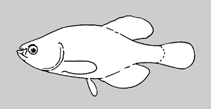
Dorsale zachte stralen (totaal) : 18 - 25; Anale zachte stralen: 18 - 23; Wervels: 28 - 30. Distinguished from all members of the Hypsolebias flavicaudatus complex, except H.
janaubensis and H. nitens, by having elongated bluish white spots on the posterior portion of the dorsal-fin base in males (vs. spots not elongated). Differs from H. nitens by having grey bars of flank in males slightly narrower, equal or slightly wider than the interspace (vs. about
two or three times wider), black spots on the middle of the flank in females larger than pupil (vs. smaller), and dorsal and anal fin filaments in males long, reaching the posterior third of the caudal fin (vs. short, reaching the anterior half of the caudal fin), and from H. janaubensis by having longer dorsal-fin base in males (38.7-43.5% SL vs. 34.4-38.4% SL), and deeper body and caudal peduncle (body depth 39.7-43.2 SL% in males and 37.2-40.8% SL in females vs. 33.9-39.5% SL and 30.7-36.8% SL, respectively; caudal peduncle depth 14.8-16.1% SL in males and 14.4-15.4% SL in females vs. 12.6-14.7% SL and 11.7-13.6% SL, respectively). Also differs from H. flavicaudatus and H. gilbertobrasili by having more grey bars on the flank in males (11-15 vs. 8-10); from H. flavicaudatus, H. gilbertobrasili and H. guanambi by the presence of short bluish white bars on the anterior portion of the dorsal-fin base in males (vs. absence); from H. radiseriatus and H. pterophylus by having shorter dorsal and anal fin filaments (reaching posterior portion of caudal fin, sometimes barely surpassing
posterior caudal-fin margin vs. in much surpassing posterior caudal-fin margin) and fewer dorsal fin filaments (2-3 vs. 4-6); from H. flavicaudatus by narrower head in males (64.1-68.8% of head length vs. 70.4-73.1%); from H. flagellatus, H. radiseriatus and H. gilbertobrasili by smaller black spot on the middle of the flank in females (smaller than eye vs. approximately equal to eye in H. flagellatus and H. radiseriatus, and greater than eye in H. gilbertobrasili). Differs also from other species of the the H. flavicaudatus complex by the rudimentary contact organs often present on the anteroventral part of the flank in males (Ref. 89836).
Body shape (shape guide): short and / or deep.
Occurs in parts of the seasonal pools more exposed to sunlight, but often with dense aquatic vegetation (Ref. 89836).
Levenscyclus en paargedrag
Maturiteit | Voortplanting | Paaien | Eieren | Fecunditeit | Larven
Costa, W.J.E.M., P.F. Amorim and J.L. Mattos, 2012. Species delimitation in annual killifishes from the Brazilian Caatinga, the Hypsolebias flavicaudatus complex (Cypriniformes: Rivulidae): implications for taxonomy and conservation. Systematics and Biodiversity 10(1):71-91. (Ref. 89836)
Status op de Rode Lijst van het IUCN (Ref. 130435: Version 2025-2 (Global))
Gevaar voor de mens
Harmless
Gebruik door de mens
Tools
Speciale rapporten
Download XML
Internetbronnen
Schattingen op basis van modellen
Fylogenetische diversiteitsindex (Ref.
82804): PD
50 = 0.5000 [Uniqueness, from 0.5 = low to 2.0 = high].
Bayesian length-weight: a=0.01995 (0.00906 - 0.04395), b=3.01 (2.83 - 3.19), in cm total length, based on all LWR estimates for this body shape (Ref.
93245).
Trofisch niveau (Ref.
69278): 3.2 ±0.4 se; based on size and trophs of closest relatives
Weerstandsvermogen (Ref.
120179): Hoog, minimale populatieverdubbelingstijd minder dan 15 maanden (Preliminary K or Fecundity.).
Kwetsbaarheid van de visserij (Ref.
59153): Low vulnerability (10 of 100).
🛈