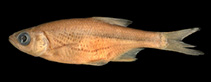
>
Cypriniformes (Carps) >
Leuciscidae (Minnows) > Leuciscinae
Etymology: Alburnoides: From the city of Al Bura, where the fish was known + particle Greek, oides = similar (Ref. 45335); holciki: Named for the late Juraj Holcík, Bratislava, in recognition of his many contributions to the science of ichthyology.
Eponymy: Dr Juraj Holčík (1934–2010) was a Czechoslovak (later Slovak) biologist and ichthyologist. [...] (Ref. 128868), visit book page.
Entorno: milieu / zona climática / rango de profundidad / gama de distribución
Ecología
; agua dulce bentopelágico. Subtropical
Asia: Hari River basin at the border of three countries including northwestern Afghanistan, northeastern Iran and southern Turkmenistan.
Tamaño / Peso / Edad
Madurez: Lm ? range ? - ? cm
Max length : 10.2 cm SL macho / no sexado; (Ref. 91777); peso máximo publicado: 19.80 g (Ref. 127972)
Descripción breve
Claves de identificación | Morfología | Morfometría
Radios blandos anales: 14 - 20; Vértebra: 40 - 42. Can be diagnosed by a combination of the following characters: ventral keel well-defined, sharp, scaleless or only slightly scaled; snout short, slightly pointed; mouth terminal with the tip of the mouth cleft on a level with the upper half of the pupil; eye large with orbit width about equal to interorbital width; 47-51 lateral-line scales to posterior margin of hypurals (47-57 total lateral-line scales); 2.5-4.2 pharyngeal teeth; dorsal-fin usually with 8½ branched rays; anal fin usually with 13-16½ branched rays; 40-42, usually 41, total vertebrae; caudal vertebral region longer than abdominal region (most frequent vertebral formulae 20+21, 20+22 and 19+21); and usually 13 or 14 predorsal vertebrae (Ref. 91777).
Body shape (shape guide): fusiform / normal.
Ciclo vital y comportamiento de apareamiento
Madurez | Reproducción | Puesta | Huevos | Fecundidad | Larva
Coad, B.W. and N.G. Bogutskaya, 2012. A new species of riffle minnow, Alburnoides holciki, from the Hari River basin in Afghanistan and Iran (Actinopterygii: Cyprinidae). Zootaxa 3453:43-55. (Ref. 91777)
Situación en la Lista Roja de la UICN (Ref. 130435: Version 2025-2 (Global))
Amenaza para el ser humano
Harmless
Usos humanos
Pesquerías: sin interés
Herramientas
Informes especiales
Descargar XML
Fuentes de Internet
Estimaciones basadas en modelos
Índice de diversidad filogenética (Referencia
82804): PD
50 = 0.5000 [Uniqueness, from 0.5 = low to 2.0 = high].
Bayesian length-weight: a=0.00759 (0.00437 - 0.01316), b=3.16 (3.02 - 3.30), in cm total length, based on LWR estimates for this species & Genus-body shape (Ref.
93245).
Nivel trófico (Referencia
69278): 3.1 ±0.4 se; based on size and trophs of closest relatives
Resiliencia (Referencia
120179): Alto, población duplicada en un tiempo mínimo inferior a 15 meses (Preliminary K or Fecundity.).
Vulnerabilidad pesquera (Ref.
59153): Low vulnerability (10 of 100).
🛈