>
Characiformes (Characins) >
Anostomidae (Headstanders)
Etymology: Pseudanos: Derived from Greek, pseudes = false (Ref. 45335); varii: Named for Richard P. Vari, ichthyologist from the National Museum of Natural History, Washington D.C., in recognition of his vast, invaluable contribution to the knowledge of systematics of characiform fishes, particularly the anostomoid fishes.
Eponymy: Dr Richard Peter Vari (1949–2016) was a curator of fish at the Smithsonian. [...] (Ref. 128868), visit book page.
Meio ambiente: milieu / Zona climática / intervalo de profundidade / faixa de distribuição
Ecologia
; Água doce bentopelágico. Tropical
South America: Rio Negro basin in Brazil, Río Síapa and Río Atabapo in Venezuela.
Tamanho / Peso / Idade
Maturidade: Lm ? range ? - ? cm
Max length : 21.0 cm SL macho/indeterminado; (Ref. 91907)
Descrição suscinta
Chaves de identificação | Morfologia | Morfometria
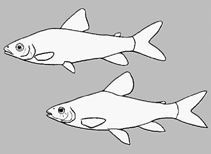
Raios dorsais (total) : 11 - 13; Vértebras: 41 - 43. Distinguished from all other species of Pseudanos by having the following characters: three branchiostegal rays (vs. four in P. gracilis and most specimens of P. winterbottomi); dark transversal bars on dorsum absent (vs. present in P. trimaculatus); dark spots present on the center of each body scale, forming conspicuous, straight dark lines (vs. dark spots absent in P. gracilis; and in some specimens of P. trimaculatus), four midlateral dark blotches on body (vs. usually two, sometimes three or four in P. trimaculatus, or body lacking midlateral blotches and presenting instead a broad midlateral stripe in P. winterbottomi); angle of the dorsal and ventralmost radii of body scales between 40° and 90° (vs. angle between 110° and 180° in P. gracilis and P. trimaculatus); and cranial fontanel opened along its entire length (vs. cranial fontanel partially closed in P. trimaculatus) (Ref. 91907).
Body shape (shape guide): fusiform / normal.
Adults occur in blackwater rivers and seasonally flooded forest on shores of river or oxbow lakes (Ref. 91907). Distinct pairs breed on densely grown weedy places (Ref. 205).
Ciclo de vida ou comportamento de acasalamento
Maturidade | Reprodução | Desova | Ovos | Fecundidade | Larvas
Distinct pairs breed on densely grown weedy places (Ref. 205).
Birindelli, J.L.O., F.C.T. Lima and H.A. Britski, 2012. New species of Pseudanos Winterbottom, 1980 (Characiformes: Anostomidae), with notes on the taxonomy of P. gracilis and P. trimaculatus. Zootaxa 3425:55-68. (Ref. 91907)
Status na Lista Vermelha da UICN (Ref. 130435: Version 2025-2 (Global))
Ameaça para os humanos
Harmless
Uso pelos humanos
Ferramentas
Relatórios especiais
Baixar XML
Fontes da internet
Estimativas baseadas em modelos
Índice de diversidade filogenética (Ref.
82804): PD
50 = 0.5312 [Uniqueness, from 0.5 = low to 2.0 = high].
Bayesian length-weight: a=0.01072 (0.00507 - 0.02267), b=3.08 (2.91 - 3.25), in cm total length, based on LWR estimates for this (Sub)family-body shape (Ref.
93245).
Nível Trófico (Ref.
69278): 2.4 ±0.1 se; based on size and trophs of closest relatives
Resiliência (Ref.
120179): médio(a), tempo mínimo de duplicação da população 1,4 - 4,4 anos (Preliminary K or Fecundity.).
Vulnerabilidade da pesca (Ref.
59153): Low vulnerability (16 of 100).
🛈