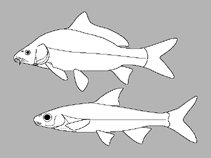
Classification / Noms
Noms communs | Synonymes | Catalog of Fishes(Genre, Espèce) | ITIS | CoL | WoRMS | Cloffa
>
Cypriniformes (Carps) >
Cyprinidae (Minnows or carps) > Smiliogastrinae
Etymology: Dawkinsia: Named for Richard Dawkins, for his contribution to the public understanding of science and, in particular, of evolutionary science.
Eponymy: Dr Clinton Richard Dawkins (d: 1941) is an ethologist and evolutionary biologist who was Professor for Public Understanding of Science (1995–2008) at Oxford, which had awarded both his bachelor’s degree (1962) and his doctorate (1966) and where he [...] (Ref. 128868), visit book page.
Environnement : milieu / zone climatique / profondeur / gamme de distribution
Écologie
; eau douce benthopélagique. Tropical
Asia: Cauvery and its tributaries across the states of Karnataka, Kerala and Tamil Nadu in India.
Taille / Poids / Âge
Maturité: Lm ? range ? - ? cm
Max length : 8.6 cm SL mâle / non sexé; (Ref. 93023)
Description synthétique
Clés d'identification | Morphologie | Morphométrie
Rayons mous dorsaux (Total) : 11; Rayons mous anaux: 8. Diagnosed from Puntius arulius by its the unique color pattern consisting of three well-defined black blotches on the body, two scales high and three scales wide, as distinct from the diffused blotches in Puntius arulius. Can be further distinguished from Puntius arulius in having a shorter dorsal-to-hypural distance, 49.8-54.6 % SL (vs. 57.3-57.6 % SL), a smaller interorbital width, 28.4-35.6 % HL (vs. 39.1-39.7 % HL) and 10-11 gill rakers in the first gill arch (vs. 8) (Ref. 93023).
Body shape (shape guide): fusiform / normal.
Cycle de vie et comportement reproducteur
Maturité | Reproduction | Frai | Œufs | Fécondité | Larves
Pethiyagoda, R., M. Meegaskumbura and K. Maduwage, 2012. A synopsis of the South Asian fishes referred to Puntius (Pisces: Cyprinidae). Ichthyol. Explor. Freshwat. 23(1):69-95. (Ref. 91036)
Statut dans la liste rouge de l'IUCN (Ref. 130435: Version 2025-2 (Global))
Menace pour l'homme
Harmless
Utilisations par l'homme
Outils
Articles particuliers
Télécharger en XML
Sources Internet
Estimations basées sur des modèles
Indice de diversité phylogénétique (Réf.
82804): PD
50 = 0.5001 [Uniqueness, from 0.5 = low to 2.0 = high].
Bayesian length-weight: a=0.01072 (0.00504 - 0.02277), b=3.02 (2.84 - 3.20), in cm total length, based on LWR estimates for this (Sub)family-body shape (Ref.
93245).
Niveau trophique (Réf.
69278): 2.7 ±0.1 se; based on size and trophs of closest relatives
Résilience (Réf.
120179): Haut, temps minimum de doublement de population inférieur à 15 mois (Preliminary K or Fecundity.).
Vulnérabilité de la pêche (Ref.
59153): Low vulnerability (10 of 100).
🛈