Clasificación / Nombres
Nombres comunes | Sinónimos | Catalog of Fishes(Género, Especie) | ITIS | CoL | WoRMS | Cloffa
>
Siluriformes (Catfishes) >
Loricariidae (Armored catfishes) > Hypoptopomatinae
Etymology: Microlepidogaster: Greek, mikros = small + Greek, lepis = scale + Greek, gaster = stomach (Ref. 45335); arachas: Named in reference to the native people Arachás who once lived in the area drained by the rio Araguari (rio das Velhas), type-locality of the new species, and were exterminated by the Caiapós in 1750s. In the Tupi language Araxá means high place where sun can be seen first, thus Arachás were the ones that inhabited the highlands of southeastern Minas Gerais State. A noun in apposition.
Eponymy: The Arachás were a native people who once lived in the area drained by the Rio Araguari – where this fish is found – in Minas Gerais, Brazil. They were exterminated by the Caiapós in the 1750s. (Ref. 128868), visit book page.
Entorno: milieu / zona climática / rango de profundidad / gama de distribución
Ecología
; agua dulce demersal. Tropical
South America: tributaries to rio Araguari, rio Perdizes, and rio Dourados, all pertaining to the rio Paranaíba drainage, upper rio Paraná basin in Brazil.
Tamaño / Peso / Edad
Madurez: Lm ? range ? - ? cm
Max length : 4.3 cm SL macho / no sexado; (Ref. 92936)
Descripción breve
Claves de identificación | Morfología | Morfometría
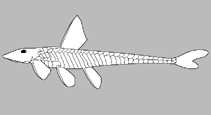
Radios blandos dorsales (total) : 8; Radios blandos anales: 6 - 7; Vértebra: 31. Distinguished from all congeners, except Microlepidogaster perforatus, by having the anterior portion of compound supraneural plus first dorsal-fin proximal radial contacting the neural spine of ninth vertebra . Differs from Microlepidogaster perforatus by possessing18-29 dentary teeth (vs. 11-15), median series of lateral plates complete, reaching caudal peduncle end, and continuous lateral line (vs. median series of lateral plates terminating two plates before the end of the caudal peduncle, with non-perforated and missing plates in the middle of the series), and 20-24 mid-dorsal plates (vs. 9-13). Can be further separated from Microlepidogaster perforatus and Microlepidogaster dimorpha by having anterior portion of rostral plates with small pointed odontodes (vs. small rounded leaf-shaped odontodes), pectoral axillary slit present only in juveniles, absent in adults specimens (vs. pectoral axillary slit persistent, present in both juveniles and adults), and 21-24 mid-ventral plates (vs. 19-20 plates in Microlepidogaster perforatus, and 17-20 plates in Microlepidogaster dimorpha). Can be diagnosed from Microlepidogaster perforatus and Microlepidogaster longicolla by presenting mid-dorsal series of lateral plates surpassing the vertical through dorsal-fin length (vs. mid-dorsal plate series reduced, reaching the vertical through dorsal-fin base, however never surpassing the dorsal-fin length); and first rib attached to seventh vertebra (vs. first rib attached to 10th or 11th vertebra) (Ref. 92936).
Body shape (shape guide): elongated.
Facultative air-breathing in the genus (Ref. 126274)
Ciclo vital y comportamiento de apareamiento
Madurez | Reproducción | Puesta | Huevos | Fecundidad | Larva
Martins, F.O., B.B. Calegari and F. Langeani, 2013. Microlepidogaster arachas, a new species of hypoptopomatine catfish (Siluriformes: Loricariidae) from the upper rio Paraná basin, Brazil. Zootaxa 3608(5):379-388. (Ref. 92936)
Situación en la Lista Roja de la UICN (Ref. 130435: Version 2025-2 (Global))
Amenaza para el ser humano
Harmless
Usos humanos
Herramientas
Informes especiales
Descargar XML
Fuentes de Internet
Estimaciones basadas en modelos
Índice de diversidad filogenética (Referencia
82804): PD
50 = 0.5039 [Uniqueness, from 0.5 = low to 2.0 = high].
Bayesian length-weight: a=0.00977 (0.00434 - 0.02202), b=3.06 (2.87 - 3.25), in cm total length, based on LWR estimates for this (Sub)family-body shape (Ref.
93245).
Vulnerabilidad pesquera (Ref.
59153): Low vulnerability (10 of 100).
🛈