वर्गीकरण / नाम
आम नाम | उपशब्द | Catalog of Fishes(वर्ग, प्रजाति) | ITIS | CoL | WoRMS | Cloffa
पर्यावरण: पर्यावरण / जलवायु क्षेत्र / गहराई सीमा / वितरण सीमा
पारिस्थितिकी
समुद्री ड़िमरसल. Deep-water
Northwest Pacific: Japan.
आकार / वज़न / आयु
परिपक्व अवधि: Lm ? range ? - ? cm
संक्षिप्त वर्णन
पहचान कुंजी | आकृति विज्ञान | मौरफोमैटरिक्स
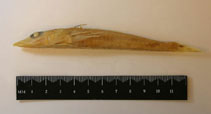
पृष्ठीय रीढ़ (सम्पूर्ण) : 6; पृष्ठीय सौफट रेज़ (सम्पूर्ण) : 14; ऐनल सौफट रेज़: 15. This species is characterized by the following: D VI,14; A 15; lateral line 40; upper side of head altogether in lack of spines and ridges; body shape most similar to B. japonicus, but is more elongated, body height 10 times in TL, head length, measured to the edge of the membranous appendage which forms continuation of the gill cover, is hardly more than 1/3 thereof; body width just behind head is slightly larger than its height. Eyes are big, diameter is about ¼ of head length, distance between very narrow, that they are almost juxtaposed. Snout rather long, ca. 3 times in head; mandible protrudes significantly in front of maxilla; mouth opening stretches back not fully to the middle of the eye; upper jawbone in rear edge has a tongue-shaped skin appendage. Whole head, with exception of upper and middle jaw, covered with rather large scales, and its upper side in total lack of ridges and spines. Operculum with 3 long ribs each ending in a weak spine; preoperculum has at its curve 2 small ones and also in the scapular region there is a small spine. Teeth are fine, comb-like and found except on jaws also at vomer and palatine. Anterior dorsal fin is rather high, its rays are weak and flexible; second ray longest, slightly longer than body height. Posterior dorsal fin somewhat higher and has its first ray longest, after which they get shorter toward the middle of fin so that the 4th and 5th are the shortest; thereafter, they become longer so the penultimate is same length as the third, the last significantly shorter. Anal fin slightly longer than dorsal fin. Pectoral fins rather short and reaching to, or slightly behind, beginning of anal fin, ray count 23. Pelvic fins slightly shorter and attached rather far in front of the pectoral fins, just behind praeoperculum angle, so that the distance from the tip of lower jaw to its root is contained 1 ½ times in the distance to the base of the pectoral fins. Scales are thin, in posterior edge very fine toothed, rather large, and easily fall off. Colour brownish with a row of darker spots along lower edge of body; lower parts almost white; first dorsal fin has in front edge a black spot, and the posterior seems to have had longitudinal dark stripes or spots arranged in rows, which is difficult to determine as the membranes between the rays are missing on both specimens; caudal fin has at the base of its upper half a black rounded spot and a hint of a couple of oblique bars; anal fin is bright with a darker band at the base; pectoral fins brown, without spots or stripes, pelvic fins white (Ref. 92385).
जीवन चक्र और संभोग व्यवहार
परिपक्व अवधि | पुनरुत्पत्ति | मछलीऔ का अंडे देना | अंडे | उपजाऊपन | लार्वा
Nyström, E., 1887. Redogörelse för den Japanska Fisksamlingen i Upsala Universitets Zoologiska Museum. Bihang till Kongl. Svenska vetenskaps-akademiens handlingar. Stockholm, 13(pt 4) No. 4: 1-54. (Ref. 92385)
आईयूसीएन रेड लिस्ट स्थिति (Ref. 130435: Version 2025-2 (Global))
मनुष्यों के लिए ख़तरा
Harmless
मानव उपयोग
साधन
विशेष रिपोर्ट
XML डाउनलोड करें
इंटरनेट स्रोत
मॉडल पर आधारित अनुमान
जातिवृति विविधता सूचकांक (संदर्भ
82804): PD
50 = 1.0002 [Uniqueness, from 0.5 = low to 2.0 = high].
Bayesian length-weight: a=0.00389 (0.00180 - 0.00842), b=3.12 (2.94 - 3.30), in cm total length, based on all LWR estimates for this body shape (Ref.
93245).
ट्रॉफिक स्तर (संदर्भ
69278): 3.7 ±0.4 se; based on size and trophs of closest relatives
मछली पकड़ने की भेद्यता (Ref.
59153): Low vulnerability (14 of 100).
🛈