>
Anguilliformes (Eels and morays) >
Ophichthidae (Snake eels) > Myrophinae
Etymology: Scolecenchelys: Greek, skolex = worm (1855) + Greek, enchlys, -yos = eel (Ref. 45335).
Eponymy: Kumakichi Aoki was a highly skilled fisherman who was assistant to Kakichi Mitsukuri at the Marine Laboratory at Misaki diuring the late 19th and early 20th centuries. [...] (Ref. 128868), visit book page.
Environnement : milieu / zone climatique / profondeur / gamme de distribution
Écologie
marin récifal; profondeur 0 - 80 m (Ref. 104540). Temperate
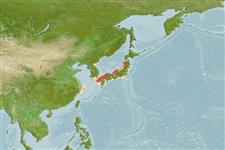
Northwest Pacific: restricted to Japanese waters, excluding northern Hokkaido and Ryukyu Archipelago, and southern Korea (Ref. 104540).
Taille / Poids / Âge
Maturité: Lm ? range ? - ? cm
Max length : 46.0 cm TL mâle / non sexé; (Ref. 104540)
Description synthétique
Clés d'identification | Morphologie | Morphométrie
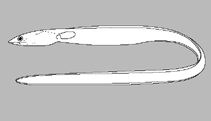
Vertèbres: 130 - 138. This elongate species of Scolecenchelys is distinguished by the following set of characters: head 7.6-10 % TL, tail 51-57 % TL; infraorbital pores 3 at postorbital area; median groove present ventrally on snout, extending anteriorly beyond level of anterior margin of tubular anterior-nostril base; acute snout; rictus of mouth slightly posterior to a vertical line through posterior margin of eye; conical and pointed teeth on upper jaw and vomer forming uniserial or biserial rows; dorsal-fin origin located posterior to a vertical line through the anus, horizontal distance between the origin and the vertical line 10-77% HL; total vertebrae 130-138, predorsal 56-65 and preanal 53-58; mean vertebral formula (MVF) 60-56-135 (Ref. 92899).
Body shape (shape guide): eel-like; Cross section: oval.
Occurs in shallow tide pools to a depth of 80 m (Ref. 104540).
Cycle de vie et comportement reproducteur
Maturité | Reproduction | Frai | Œufs | Fécondité | Larves
Hibino, Y. and S. Kimura, 2015. Revision of the Scolecenchelys gymnota species group with descriptions of two new species (Anguilliformes: Ophichthidae: Myrophinae). Ichthyol Res (Ref. 104540)
Statut dans la liste rouge de l'IUCN (Ref. 130435: Version 2025-2 (Global))
Menace pour l'homme
Harmless
Utilisations par l'homme
Outils
Articles particuliers
Télécharger en XML
Sources Internet
Estimations basées sur des modèles
Température préférée (Réf.
123201): 17.5 - 21.4, mean 20.5 °C (based on 20 cells).
Indice de diversité phylogénétique (Réf.
82804): PD
50 = 0.5000 [Uniqueness, from 0.5 = low to 2.0 = high].
Bayesian length-weight: a=0.00076 (0.00029 - 0.00201), b=3.06 (2.83 - 3.29), in cm total length, based on LWR estimates for this (Sub)family-body shape (Ref.
93245).
Niveau trophique (Réf.
69278): 4.1 ±0.7 se; based on size and trophs of closest relatives
Résilience (Réf.
120179): Haut, temps minimum de doublement de population inférieur à 15 mois (Preliminary K or Fecundity.).
Vulnérabilité de la pêche (Ref.
59153): Moderate vulnerability (36 of 100).
🛈