Classification / Noms
Noms communs | Synonymes | Catalog of Fishes(Genre, Espèce) | ITIS | CoL | WoRMS | Cloffa
>
Cichliformes (Cichlids, convict blennies) >
Cichlidae (Cichlids) > Pseudocrenilabrinae
Etymology: Eretmodus: Greek, eretmos, -ou = with oars + Greek, odous = teeth (Ref. 45335); marksmithi: The species is named marksmithi for Mark Smith, ardent cichlid fancier and breeder, photographer, and author, who was instrumental in obtaining specimens and photographs of this new species (Ref. 92306).
Eponymy: Mark Smith is an American aquarist who specialises in Rift Valley cichlids. He is also a photographer of aquatic wildlife, an explorer and a writer. Among his books is: Lake Malawi Cichlids (2001). (Ref. 128868), visit book page.
Environnement : milieu / zone climatique / profondeur / gamme de distribution
Écologie
; eau douce pélagique; profondeur 0 - 5 m (Ref. 92306). Tropical
Africa: endemic to Lake Tanganyika, occurs in the northern two thirds to three-fourths of the lake (Ref. 92306).
Taille / Poids / Âge
Maturité: Lm ? range ? - ? cm
Max length : 4.7 cm SL mâle / non sexé; (Ref. 92306)
Description synthétique
Clés d'identification | Morphologie | Morphométrie
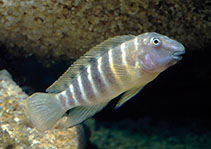
Épines dorsales (Total) : 23 - 25; Rayons mous dorsaux (Total) : 3 - 5; Épines anales: 3; Rayons mous anaux: 7 - 8. Diagnosis: Eretmodus marksmithi is characterized by a subterminal mouth and 7-8 light bars extending the full depth of the body from dorsal fin base to ventral side, the last crossing the caudal peduncle (Ref. 92306). A few light blue dots may be present, mainly on the head (Ref. 92306).
Body shape (shape guide): short and / or deep; Cross section: compressed.
Found in shallow (1-2 m deep), well-oxygenated, clear water of the surge zone; bottom composed of small stones varying from 10-40 cm in diameter; feeds on biocover which is scraped from rocks; small invertebrates (crustaceans, mites, insects, insect larvae) are eaten as well; biparental mouthbrooder (Ref. 92306).
Cycle de vie et comportement reproducteur
Maturité | Reproduction | Frai | Œufs | Fécondité | Larves
Burgess, W.E., 2012. A new species of goby cichlid of the genus Eretmodus, E. marksmithi, (Pisces: Cichlidae) from the northern part of Lake Tanganyika. Tanganika Mag. 12:23-31. (Ref. 92306)
Statut dans la liste rouge de l'IUCN (Ref. 130435: Version 2025-2 (Global))
Menace pour l'homme
Harmless
Utilisations par l'homme
Aquarium: Commercial
Outils
Articles particuliers
Télécharger en XML
Sources Internet
Estimations basées sur des modèles
Indice de diversité phylogénétique (Réf.
82804): PD
50 = 0.7500 [Uniqueness, from 0.5 = low to 2.0 = high].
Bayesian length-weight: a=0.01905 (0.00846 - 0.04293), b=3.01 (2.82 - 3.20), in cm total length, based on LWR estimates for this (Sub)family-body shape (Ref.
93245).
Niveau trophique (Réf.
69278): 3.2 ±0.4 se; based on size and trophs of closest relatives
Vulnérabilité de la pêche (Ref.
59153): Low vulnerability (10 of 100).
🛈