การจำแนกประเภท / ชื่อ
ชื่อสามัญ | ชื่อพ้อง | Catalog of Fishes(สกุล, ชนิด) | ITIS | CoL | WoRMS | Cloffa
>
Cichliformes (Cichlids, convict blennies) >
Cichlidae (Cichlids) > Cichlinae
Etymology: Congolapia: Congolapia is a contraction of the words Congo and Tilapia; all species of Congolapia are only known from the central Congo basin.
สิ่งแวดล้อม : สิ่งแวดล้อม / เขตภูมิอากาศ / ระดับความลึก / ระยะการกระจายสินค้า
นิเวศวิทยา
; น้ำจืด ผิวน้ำ. Tropical
Africa: the western central Congo basin (Republic of Congo and Democratic Republic of the Congo), from the Alima, Lefini, Sangha, Pool Malebo, Itimbiri and from affluents of Luilaka (Ref. 92878).
ขนาด / น้ำหนัก / อายุ
วัยเจริญพันธุ์: Lm ? range ? - ? cm
Max length : 14.7 cm SL เพศผู้/กระเทย; (Ref. 92878)
คำอธิบายสั้นๆ
เครื่องมือที่ใช้ในการแยกชนิดสัตว์,สิ่งมีชีวิตออกจากกัน | สัณฐานวิทยา | ความยาวต่างๆ
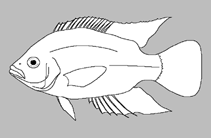
เงี่ยงครีบหลัง (รวม) : 16 - 17; ก้านครีบอ่อนที่หาง (รวม) : 8 - 10; เงี่ยงครีบก้น: 3; ก้านครีบอ่อนที่ก้น: 7 - 9. Diagnosis: Congolapia crassa differs from C. bilineata by having two complete scale rows between the upper lateral line and the base of the last dorsal spine and one additional row of very small scales in-between vs. one complete scale row and one additional scale row with smaller dorsoventrally compressed scales between the upper lateral line and the base of the last dorsal spine (Ref. 92878). It is distinguished from C. louna by a lower number of gill rakers on first ceratobranchial, 8-11 vs. 13 (Ref. 92878). Further, C. crassa differs from C. bilineata and C. louna by a greater body depth with only a minimal overlap, 40.4-48.4% of standard length vs. 32-2-40.5% and 37.4-42.1% respectively (Ref. 92878). All scales cycloid; 25-27 scales on horizontal line; 18-21 upper lateral line scales; 8-11 lower lateral line scales (Ref. 92878).
Colour: Background colour reddish-brown to bluish, chest and belly light brown to whitish with small reddish elements and dorsum darker brown, especially in range of backward slanted, unbranched (not Y-shaped) bars; flank below lateral line more bluish; lower half of head light brown to reddish and upper half of head dark olive-brown; upper lip turquoise and lower lip whitish; a horizontal iridescent turquoise line above anterorostral margin of preopercle; base of pectoral fin whitish edged; iris reddish brown (Ref. 92878). Apparently depending on motivational state, body with five or six black, broad, backward slanted, unbranched (not Y-shaped) bars and a nape band; bluish thin lachrymal stripe extending from lachrymal to jaw angle; black opercular spot, extended into sloping stripe (Ref. 92878). Pectoral fin light yellowish to hyaline, pelvic and anal fin greenish yellow; dorsal fin reddish-brown to yellow-whitiwh edged, black 'tilapia spot' present; caudal fin reddish-brown to yellow, whitish edged (Ref. 92878).
Congolapia crassa is found in grass-bank as well as forest-bank habitats, and this during the dry as well as wet season (Ref. 92878).
วงจรชีวิตและพฤติกรรมการผสมพันธุ์
วัยเจริญพันธุ์ | การสืบพันธุ์ | การวางไข่ | เซลสืบพันธ์ของเพศเมีย(ไข่) | ความดกของไข่ | ตัวอ่อน
Dunz, A.R., E. Vreven and U.K. Schliewen, 2012. Congolapia, a new cichlid genus from the central Congo basin (Perciformes: Cichlidae). Ichthyol. Explor. Freshwat. 23(2):155-179. (Ref. 92878)
สถานะบัญชีแดงของ IUCN (Ref. 130435: Version 2025-2 (Global))
ภัยคุกคามต่อมนุษย์
Harmless
การใช้ของมนุษย์
เครื่องมือ
รายงานพิเศษ
ดาวน์โหลด XML
แหล่งที่มาจากอินเตอร์เน็ต
การประมาณค่าตามแบบจำลอง
ดัชนีความหลากหลายทางวิวัฒนาการ (อ้างอิง
82804): PD
50 = 0.6250 [Uniqueness, from 0.5 = low to 2.0 = high].
Bayesian length-weight: a=0.00776 (0.00352 - 0.01710), b=3.12 (2.94 - 3.30), in cm total length, based on LWR estimates for this (Sub)family-body shape (Ref.
93245).
ระดับชั้นอาหาร (อ้างอิง
69278): 3.2 ±0.5 se; based on size and trophs of closest relatives
ความสามารถในการกลับคืนสู่ปกติ (อ้างอิง
120179): ความสูง, เวลาต่ำสุดที่จะทำให้ประชากรเพิ่มขึ้นเป็น 2 เท่าใช้เวลาน้อยกว่า 15 เดือน (Preliminary K or Fecundity.).
ความเสี่ยงต่อการตกปลา (Ref.
59153): Low vulnerability (10 of 100).
🛈