Klassifizierung / Names
Namen | Synonyme | Catalog of Fishes(Gattung, Arten) | ITIS | CoL | WoRMS | Cloffa
>
Anguilliformes (Eels and morays) >
Ophichthidae (Snake eels) > Myrophinae
Etymology: Pylorobranchus: From the Greek pylorus (gatekeeper) and branchos (gill), neuter, in reference to the lappet-like structure located before the gill opening; hoi: Named for Hsuan-Ching Ho, who has studied the eels and many other fishes of Taiwan.
Eponymy: Dr Hsuan-Ching Ho (d: 1978) is a Taiwanese ichthyologist who is Associate Professor at the Institute of Marine Biology at the National Dong Hwa University, Taiwan (2014–present). [...] (Ref. 128868), visit book page.
Umwelt: Milieu / Klimazone / Tiefenbereich / Verbreitungsgebiet
Ökologie
seewasser benthopelagisch; tiefenbereich ? - 300 m (Ref. 92848). Subtropical
Northwest Pacific: Taiwan.
Größe / Gewicht / Alter
Geschlechtsreife: Lm ? range ? - ? cm
Deprecated: number_format(): Passing null to parameter #1 ($num) of type float is deprecated in /var/www/html/includes/common.lib.php on line 1833
Max length : 56.8 cm TL Männchen/unbestimmt; (Ref. 92848); 67.6 cm TL (female); max. veröff. Gewicht: 0.00 g
Kurzbeschreibung
Bestimmungsschlüssel | Morphologie | Morphometrie
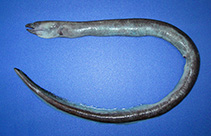
Wirbelzahl: 182 - 183. This moderately elongate myrophin is distinguished by the following characters: tail 52%-59% of
TL; dorsal fin arising in anterior trunk region; median fins elevated; pectoral fin rounded, developed,
twice eye diameter; gill opening preceded anteromedially by a small lappet-like fleshy protuberance;
rear margin of orbit above rictus; cephalic pores developed, SO 1+3, IO 4+2, POM 6+3, and ST 3
present; teeth conical, developed, uniserial in jaws and vomer; coloration brown, median fins white,
anal-fin membrane black posteriorly; vertebral formula 30.3/62.7/182.3, total vertebrae 182 or 183 (Ref. 92848).
Body shape (shape guide): eel-like; Cross section: compressed.
Collected from sand and rocky bottom (Ref. 92848).
Lebenszyklus und Paarungsverhalten
Geschlechtsreife | Fortpflanzung | Ablaichen | Eier | Fruchtbarkeit | Larven
McCosker, J.E., K.-H. Loh, J. Lin and H.-M. Chen, 2012. Pylorobranchus hoi, a new genus and species of Myrophine worm-eel from Taiwan (Anguilliformes: Ophichtidae). Zool. Stud. 52(1) (Ref. 92848)
IUCN Rote Liste Status (Ref. 130435: Version 2025-2 (Global))
Bedrohung für Menschen
Harmless
Nutzung durch Menschen
Tools
Zusatzinformationen
Download XML
Internet Quellen
Schätzungen auf der Grundlage von Modellen
Phylogenetischer Diversitätsindex (Ref.
82804): PD
50 = 0.7500 [Uniqueness, from 0.5 = low to 2.0 = high].
Bayesian length-weight: a=0.00076 (0.00029 - 0.00201), b=3.06 (2.83 - 3.29), in cm total length, based on LWR estimates for this (Sub)family-body shape (Ref.
93245).
Trophische Ebene (Ref.
69278): 4.3 ±0.7 se; based on size and trophs of closest relatives
Widerstandsfähigkeit (Ref.
120179): mittel, Verdopplung der Population dauert 1,4 - 4,4 Jahre. (Preliminary K or Fecundity.).
Anfälligkeit der Fischerei (Ref.
59153): Moderate to high vulnerability (47 of 100).
🛈