>
Centrarchiformes (Basses) >
Kyphosidae (Sea chubs)
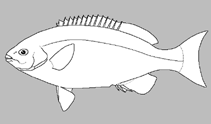
Etymology: Kyphosus: Greek, kyphos = bent (Ref. 45335); gladius: Named for its body shape, resembling the roman gladius sword (widest towards the point and tapers towards the hilt) with the relatively elongate body and shallow caudal peduncle, along with the metallic-bluish colouration.
Environnement : milieu / zone climatique / profondeur / gamme de distribution
Écologie
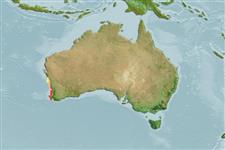
marin pelagic-neritic; profondeur 0 - 15 m (Ref. 92523). Subtropical; 28°S - 35°S, 113°E - 118°E (Ref. 92523)
Eastern Indian Ocean: endemic to Western Australia.
Taille / Poids / Âge
Maturité: Lm ? range ? - ? cm
Max length : 45.7 cm SL mâle / non sexé; (Ref. 92523)
Description synthétique
Clés d'identification | Morphologie | Morphométrie
Épines dorsales (Total) : 10 - 11; Rayons mous dorsaux (Total) : 11 - 12; Épines anales: 3; Rayons mous anaux: 11 - 12; Vertèbres: 26. This species is distinguished from its congeners from the Indian Ocean and the Pacific Ocean by the following set of characters: body elliptical and elongate in lateral view and compressed; D X-XI,11-12; A III,11-12, anal fin base short 16.9-20.6% SL; total gill rakers externally 15-19, gill rakers on upper limb externally 3-5, gill rakers on lower limb externally 11-15; long caudal peduncle 18.7-26.5%SL (depth 9.9-11.8% SL); total lateral line 55-64, pored scales 44-55, scale rows in longitudinal row 49-57; precaudal- and caudal vertebrae 10+16; pterygiophores, dorsal 21, anal 12; mouth terminal; silvery line under eye, colour silvery to bluish metallic; operculum with a vertical green bar running down rear of preoperculum; dorsal part of body without dark counter-shading; sixth dorsal fin spine length, 8.7-11.9 % SL; body depth, 33.3-41.6 % SL (Ref. 92523).
Body shape (shape guide): elongated; Cross section: compressed.
Maximum length of individuals observed from the wild may be in excess of 52 cm SL (Ref. 92523).
Cycle de vie et comportement reproducteur
Maturité | Reproduction | Frai | Œufs | Fécondité | Larves
Knudsen, S.W. and K.D. Clements, 2013. Revision of the fish family Kyphosidae (Teleostei: Perciformes). Zootaxa 3751(1):001-101. (Ref. 95491)
Statut dans la liste rouge de l'IUCN (Ref. 130435: Version 2025-2 (Global))
Menace pour l'homme
Harmless
Utilisations par l'homme
Outils
Articles particuliers
Télécharger en XML
Sources Internet
Estimations basées sur des modèles
Température préférée (Réf.
123201): 19.3 - 21.2, mean 20.6 °C (based on 16 cells).
Indice de diversité phylogénétique (Réf.
82804): PD
50 = 0.5000 [Uniqueness, from 0.5 = low to 2.0 = high].
Bayesian length-weight: a=0.00389 (0.00180 - 0.00842), b=3.12 (2.94 - 3.30), in cm total length, based on all LWR estimates for this body shape (Ref.
93245).
Résilience (Réf.
120179): Milieu, temps minimum de doublement de population : 1,4 à 4,4 années (Preliminary K or Fecundity.).
Vulnérabilité de la pêche (Ref.
59153): Moderate vulnerability (42 of 100).
🛈
Nutriments (Ref.
124155): Calcium = 101 [47, 189] mg/100g; Iron = 1.23 [0.66, 2.21] mg/100g; Protein = 18.3 [17.1, 19.5] %; Omega3 = 0.165 [0.083, 0.328] g/100g; Selenium = 17.9 [7.8, 42.5] μg/100g; VitaminA = 11.6 [2.5, 50.8] μg/100g; Zinc = 1.28 [0.87, 1.91] mg/100g (wet weight);