>
Trachichthyiformes (Roughies) >
Trachichthyidae (Slimeheads)
Etymology: Hoplostethus: Greek, hoplon = weapon + Greek, stetho, stethion = brest; literal = to prick a little breast (Ref. 45335); melanopeza: Name from Greek 'melano' for ‘black’ and 'peza‘ for 'edge’; referring to the characteristic black edge on all fins in large individuals of this species; noun in apposition.
Ambiente: milieu / zona climatica / distribuzione batimetrica / gamma di distribuzione
Ecologia
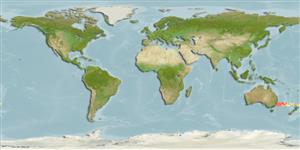
marino pelagic-oceanic; distribuzione batimetrica 250 - 400 m (Ref. 92805). Subtropical; 33°S - 37°S (Ref. 92805)
South Pacific: sub-tropical and temperate latitudes of the Tasman and South Fiji Basins; SE Australian slopes on the west to the outer Bay of Plenty and southern Kermadec Ridge at the north end of the North Island in New Zealand in the east.
Dimensione / Peso / Età
Maturità: Lm ? range ? - ? cm
Max length : 51.5 cm SL maschio/sesso non determinato; (Ref. 92805)
Breve descrizione
Chiavi di identificazione | Morfologia | Morfometria
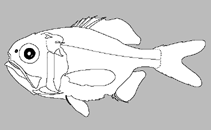
Spine dorsali (totale) : 6 - 7; Raggi dorsali molli (totale) : 12 - 13; Spine anali: 3; Raggi anali molli: 3 - 10. This species is distinguished by the following characters: 15 pectoral-fin rays, rarely 13, 14 or 16; 18-21 total gill rakers on outer side of first arch; 9-12 abdominal scutes, some scutes in large individuals with multiple apical points; 16-22 predorsal scales; isthmus lacking scales; body scales adherent; lateral–line scales with strong medial ridge, but no spine in small and medium sized adults, with strong spine centrally on posterior margin in large adults; scales on predorsal midline forming low raised ridge; body ovoid and deep, depth 1.9-2.1 in SL; nape gently curved, forehead almost straight to above upper lip; dorsal- and anal-fin spines of moderate thickness; body of adults grey, superimposed with deep red in life, outer margin of all fins with narrow black edge in adults; buccal cavity and opercular recess black, vomer, margins of mouth roof lateral to palatines, underside of tongue and upper surface of lower jaw stark white (Ref. 92805).
Body shape (shape guide): short and / or deep; Cross section: compressed.
Inhabits continental slopes, seamounts and submarine rises with collection depths recorded between about 140 and 760 m, but most often 250-400 m (Ref. 92805).
Ciclo vitale e comportamento di accoppiamento
Maturità | Riproduzione | Deposizione | Uova | Fecondità | Larve
Roberts, C.D. and M.F. Gomon, 2012. A review of giant roughies of the genus Hoplostethus (Beryciformes, Trachichthyidae), with descriptions of two new Australasian species. Memoirs of Museum Victoria 69:341-354. (Ref. 92805)
Stato della Lista Rossa IUCN (Ref. 130435: Version 2025-2 (Global))
Minaccia per l'uomo
Harmless
Usi umani
Strumenti
Rapporti speciali
Scarica XML
Fonti Internet
Stime basate su modelli
Temperatura preferita (Fonte Biblio.
123201): 4.3 - 9.7, mean 5.4 °C (based on 46 cells).
Indice di diversità filogenetica (Fonte Biblio.
82804): PD
50 = 0.5000 [Uniqueness, from 0.5 = low to 2.0 = high].
Bayesian length-weight: a=0.01660 (0.00717 - 0.03842), b=3.05 (2.86 - 3.24), in cm total length, based on LWR estimates for this (Sub)family-body shape (Ref.
93245).
Livello trofico (Fonte Biblio.
69278): 3.7 ±0.6 se; based on size and trophs of closest relatives
Resilienza (Fonte Biblio.
120179): Molto basso, tempo minimo di raddoppiamento della popolazione più di 14 anni (Preliminary K or Fecundity.).
Vulnerabilità della pesca (Ref.
59153): Moderate to high vulnerability (45 of 100).
🛈