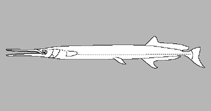
Classificação / Nomes
Nomes comuns | Sinónimos | Catalog of Fishes(Género, Espécies) | ITIS | CoL | WoRMS | Cloffa
>
Beloniformes (Needle fishes) >
Belonidae (Needlefishes)
Etymology: Potamorrhaphis: Greek, potamos = river + Greek, rhaphis = needle (Ref. 45335); labiata: Name from Latin word meaning large-lipped, referring to the expanded labial membrane diagnostic of this species; an adjective.
Ambiente: milieu / zona climática / intervalo de profundidade / gama de distribuição
Ecologia
; Água doce pelágico(a,os,as); intervalo de profundidade 0 - ? m. Tropical
South America: Brazil.
Tamanho / Peso / Idade
Maturidade: Lm ? range ? - ? cm
Max length : 17.5 cm OT macho/indeterminado; (Ref. )
Descrição breve
Chaves de identificação | Morfologia | Morfometria
Raios dorsais moles (total) : 29 - 34; Raios anais moles: 25 - 29. This species can be distinguished from Potamorrhaphis eigenmanni and P. guianensis by having the posterior third of the labial membrane highly expanded laterally, reaching to or passing the level of the ventral margin of the maxilla when folded ventrally (vs. narrow, not reaching the level of the ventral margin of the maxilla when folded ventrally); from P. eigenmanni by having 3 rows of accessory teeth on the lower jaw (vs. 2 rows), and 115-128 scales on the lateral line (vs. 97-119); from P. guianensis by having the contralateral branchiostegal membranes overlapping in the midventral line (vs. branchiostegal membranes not overlapping ventrally), 3 rows of accessory teeth on the lower jaw (vs. 4 rows), and dentary with coronoid process salient (vs. coronoid process not salient); from P. petersi by the coloration of the labial membrane with melanophores only in the inner margin (vs. melanophores uniformly distributed), 29-34 dorsal-fin rays (vs. 35-43), 25-29 anal-fin rays (vs. 30-39), deeper caudal peduncle (2.1-2.7 vs. 1.1-1.6% BL), longer predorsal length (62.9-67.6 vs. 59.5-62.8% BL), longer pectoral-pelvic distance (38.5-42.6 vs. 36.0-38.1% BL), and longer head length (17.6-18.9 versus 15.8-17.9% BL) (Ref. 92518).
Length type used is body length (BL), measured from the anterior margin of the nasal bone to the hypural plate (Ref. 92518).
Ciclo de vida e comportamento de acasalamento
Maturidade | Reprodução | Desova | Ovos | Fecundidade | Larvas
Sant'Anna, V.B., M.L.S Delapieve and R.E. Reis, 2012. A new species of Potamorrhaphis (Beloniformes: Belonidae) from the Amazon Basin. Copeia, 2012(4):663-669. (Ref. 92518)
Categoria na Lista Vermelha da IUCN (Ref. 130435: Version 2025-2 (Global))
Ameaça para o homem
Harmless
Utilização humana
Ferramentas
Relatórios especiais
Descarregue XML
Fontes da internet
Estimativas baseadas em modelos
Índice de diversidade filogenética (Ref.
82804): PD
50 = 0.5625 [Uniqueness, from 0.5 = low to 2.0 = high].
Bayesian length-weight: a=0.00126 (0.00057 - 0.00279), b=3.11 (2.93 - 3.29), in cm total length, based on LWR estimates for this (Sub)family-body shape (Ref.
93245).
Nível Trófico (Ref.
69278): 3.9 ±0.6 se; based on size and trophs of closest relatives
Resiliência (Ref.
120179): Elevada, tempo mínimo de duplicação da população menor que 15 meses (Preliminary K or Fecundity.).
Vulnerabilidade da pesca (Ref.
59153): Low vulnerability (19 of 100).
🛈