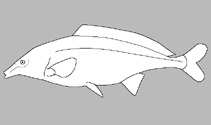
>
Osteoglossiformes (Bony tongues) >
Mormyridae (Elephantfishes)
Etymology: Petrocephalus: Latin, petra = stone + Greek, kephale = head (Ref. 45335); petersi: The species name petersi is given in honour of the German herpetologist Wilhelm C.H. Peters who had carried out a major fish survey of the lower Zambezi region, and discovered many of the endemics and other widespread species during his 'Naturwissenschaftliche Reise nach Mossambique 1842-1848' (Ref. 91771).
Eponymy: Wilhelm Karl Hartwig Peters (1815–1883) was a German zoologist and traveller who made some very important collections in Mozambique. [...] (Ref. 128868), visit book page.
Environnement : milieu / zone climatique / profondeur / gamme de distribution
Écologie
; eau douce démersal. Tropical
Africa: Zambezi River Delta and Melela River (Ref. 91771).
Taille / Poids / Âge
Maturité: Lm ? range ? - ? cm
Max length : 7.3 cm SL mâle / non sexé; (Ref. 91771)
Description synthétique
Clés d'identification | Morphologie | Morphométrie
Épines dorsales (Total) : 0; Rayons mous dorsaux (Total) : 18 - 20; Épines anales: 0; Rayons mous anaux: 25 - 26. Diagnosis: Body depth 28.7-32.3% of standard length; predorsal length 62.3-65.8% of standard length; preanal length 59.5-63.7% of standard length; length of snout to centre of eye 34.5-38.3% of head length; length of snout to posterior orbital rim of eye 44.2-47.9% of head length; number of scales around caudal peduncle 12-16 (Ref. 91771).
Body shape (shape guide): fusiform / normal.
Habitat of type locality is a medium-sized stream, sand substrate with lots of leaf litter and marginal grass; prefers freshwater (<1% salinity) (Ref. 91771).
Cycle de vie et comportement reproducteur
Maturité | Reproduction | Frai | Œufs | Fécondité | Larves
Kramer, B., R. Bills, P. Skelton and M. Wink, 2012. A critical revision of the churchill snoutfish, genus Petrocephalus Marcusen, 1854 (Actinopterygii: Teleostei: Mormyridae), from southern and eastern Africa, with the recognition of Petrocephalus tanensis, and the description of five new species. Journal of Natural History 46(35-36):2179-2258. (Ref. 91771)
Statut dans la liste rouge de l'IUCN (Ref. 130435: Version 2025-2 (Global))
Menace pour l'homme
Harmless
Utilisations par l'homme
Pêcheries: sans intérêt
Outils
Articles particuliers
Télécharger en XML
Sources Internet
Estimations basées sur des modèles
Indice de diversité phylogénétique (Réf.
82804): PD
50 = 0.5000 [Uniqueness, from 0.5 = low to 2.0 = high].
Bayesian length-weight: a=0.01549 (0.00672 - 0.03569), b=2.87 (2.69 - 3.05), in cm total length, based on LWR estimates for this Genus-body shape (Ref.
93245).
Niveau trophique (Réf.
69278): 3.2 ±0.4 se; based on size and trophs of closest relatives
Vulnérabilité de la pêche (Ref.
59153): Low vulnerability (10 of 100).
🛈