Classificazione / Nomi
Nomi Comuni | Sinonimi | Catalog of Fishes(Genere, Specie) | ITIS | CoL | WoRMS | Cloffa
>
Perciformes/Percoidei (Perchs) >
Percidae (Perches) > Etheostomatinae
Etymology: Etheostoma: Greek, etheo = to strain + Greek, stoma = mouth; Rafinesque said "various mouths", but Jordan and Evermann suggest the name might have been intended as "Heterostoma (Ref. 45335); gore: Named for Al Gore, the 45th Vice President of the United States of America, serving with President
Bill Clinton, and for his environmental vision, commitment, and accomplishments throughout decades of public service and his role in educating the public and raising awareness on the issue of global climate change; noun in apposition.
Ambiente: milieu / zona climatica / distribuzione batimetrica / gamma di distribuzione
Ecologia
; acqua dolce benthopelagico. Temperate
North America: United States of America (Kentucky and Tennessee).
Dimensione / Peso / Età
Maturità: Lm ? range ? - ? cm
Max length : 4.3 cm SL maschio/sesso non determinato; (Ref. 92294); 4.1 cm SL (female)
Breve descrizione
Chiavi di identificazione | Morfologia | Morfometria
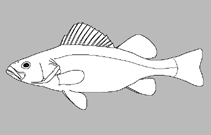
Spine dorsali (totale) : 10 - 14; Raggi dorsali molli (totale) : 10 - 13; Spine anali: 2; Raggi anali molli: 5 - 10. This species is distinguished by the following characters: the breeding male with spinous dorsal fin with blue marginal and submedial bands, orange medial band, basal band with bright orange pigment; soft dorsal, caudal, and pectoral fins with distinct bright orange spots on rays; the soft dorsal and anal fins has blue in base of fin and the anal fin with distinct orange spots on rays; the face and lower head tangerine orange with blue on operculum, preoperculum, cheek, and suborbital bar (not on lips and mid-gular region); quadrate lateral blue blotches extend ventrad from lateral line scale row; basicaudal blue bar extending from dorsal to ventral margin of caudal fin; absence of frenum; incomplete lateral line, unpored scales modally greater than 10 (11); cheek naked or nearly naked.; no palatine teeth; dorsal fin with spines modally 12 and soft rays modally 11; anal fin soft rays modally 8-9; pectoral fin rays modally 14; principal caudal fin rays modally 15; caudal peduncle scales modally 16; preoperculomandibular canal pores modally 10 (Ref. 92294).
Ciclo vitale e comportamento di accoppiamento
Maturità | Riproduzione | Deposizione | Uova | Fecondità | Larve
Layman, S.R. and R.L. Mayden, 2012. Morphological diversity and phylogenetics of the darter subgenus Doration (Percidae: Etheostoma), with descriptions of five new species. Bulletin of the Alabama Museum of Natural History 30:1-83. (Ref. 92294)
Stato della Lista Rossa IUCN (Ref. 130435: Version 2025-2 (Global))
Minaccia per l'uomo
Harmless
Usi umani
Strumenti
Rapporti speciali
Scarica XML
Fonti Internet
Stime basate su modelli
Indice di diversità filogenetica (Fonte Biblio.
82804): PD
50 = 0.5000 [Uniqueness, from 0.5 = low to 2.0 = high].
Bayesian length-weight: a=0.00676 (0.00303 - 0.01510), b=3.12 (2.94 - 3.30), in cm total length, based on LWR estimates for this Genus-body shape (Ref.
93245).
Livello trofico (Fonte Biblio.
69278): 3.2 ±0.5 se; based on size and trophs of closest relatives
Resilienza (Fonte Biblio.
120179): Alto, tempo minimo di raddoppiamento della popolazione meno di 15 mesi (Preliminary K or Fecundity.).
Vulnerabilità della pesca (Ref.
59153): Low vulnerability (10 of 100).
🛈