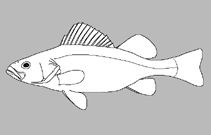
Klassifizierung / Names
Namen | Synonyme | Catalog of Fishes(Gattung, Arten) | ITIS | CoL | WoRMS | Cloffa
>
Perciformes/Percoidei (Perchs) >
Percidae (Perches) > Etheostomatinae
Etymology: Etheostoma: Greek, etheo = to strain + Greek, stoma = mouth; Rafinesque said "various mouths", but Jordan and Evermann suggest the name might have been intended as "Heterostoma (Ref. 45335); clinton: Named for President Bill Clinton, the 42nd President of the United States of America, for his lasting environmental accomplishments in creating and expanding national monuments, preserving millions of acres of wilderness areas, his leadership and commitment during challenging economic times, and his continued commitment to global humanitarian issues and needs and peace; noun in apposition.
Eponymy: President William Jefferson ‘Bill’ Clinton né Blyth III was the 42nd President of the USA. He was honoured for his lasting environmental accomplishments. (Ref. 128868), visit book page.
Umwelt: Milieu / Klimazone / Tiefenbereich / Verbreitungsgebiet
Ökologie
; süßwasser benthopelagisch. Temperate
North America: United States of America (upper Caddo and upper Ouachita rivers upstream of the Fall Line in the Ouachita Mountains province of Arkansas).
Größe / Gewicht / Alter
Geschlechtsreife: Lm ? range ? - ? cm
Max length : 3.5 cm SL Männchen/unbestimmt; (Ref. 92294); 3.4 cm SL (female)
Kurzbeschreibung
Bestimmungsschlüssel | Morphologie | Morphometrie
Rückenflossenstacheln (insgesamt) : 10 - 13; Rückenflossenweichstrahlen (insgesamt) : 10 - 13; Afterflossenstacheln: 2; Afterflossenweichstrahlen: 7 - 10. The breeding male of this species, a member of the subgenus Doration. Is distinguished by: the following characters: spinous dorsal fin with blue-green marginal and submedial bands, red-orange medial band, basal band lacking bright orange pigment; soft dorsal, caudal, and pectoral fins without distinct orange spots on rays; soft dorsal and anal fins with bluegreen in base of fin; face and lower head gray with blue or blue-green on operculum, preoperculum, suborbital bar, lips, and mid-gular region; quadrate lateral blue-green blotches with narrow continuous midlateral band of melanophores running through blotches; blue-green wedge on ventral half of caudal fin base but not developed dorsally. In addition, the frenum is absent; lateral line is incomplete, unpored scales modally, greater than 10 (14); cheek is usually naked; presence of palatine teeth; dorsal fin spines modally 11, soft rays modally 11; anal fin soft rays modally 9; pectoral fin rays modally 13-14; principal caudal fin rays modally 15; caudal peduncle scales modally 16; preoperculomandibular canal pores modally 9 (Ref. 92294).
Cross section: oval.
Lebenszyklus und Paarungsverhalten
Geschlechtsreife | Fortpflanzung | Ablaichen | Eier | Fruchtbarkeit | Larven
Layman, S.R. and R.L. Mayden, 2012. Morphological diversity and phylogenetics of the darter subgenus Doration (Percidae: Etheostoma), with descriptions of five new species. Bulletin of the Alabama Museum of Natural History 30:1-83. (Ref. 92294)
IUCN Rote Liste Status (Ref. 130435: Version 2025-2 (Global))
Bedrohung für Menschen
Harmless
Nutzung durch Menschen
Tools
Zusatzinformationen
Download XML
Internet Quellen
Schätzungen auf der Grundlage von Modellen
Phylogenetischer Diversitätsindex (Ref.
82804): PD
50 = 0.5000 [Uniqueness, from 0.5 = low to 2.0 = high].
Bayesian length-weight: a=0.00676 (0.00303 - 0.01510), b=3.12 (2.94 - 3.30), in cm total length, based on LWR estimates for this Genus-body shape (Ref.
93245).
Trophische Ebene (Ref.
69278): 3.2 ±0.4 se; based on size and trophs of closest relatives
Widerstandsfähigkeit (Ref.
120179): hoch, Verdopplung der Population dauert weniger als 15 Monate. (Preliminary K or Fecundity.).
Anfälligkeit der Fischerei (Ref.
59153): Low vulnerability (10 of 100).
🛈