Clasificación / Nombres
Nombres comunes | Sinónimos | Catalog of Fishes(Género, Especie) | ITIS | CoL | WoRMS | Cloffa
>
Cichliformes (Cichlids, convict blennies) >
Cichlidae (Cichlids) > Cichlinae
Etymology: Mazarunia: Taken from river Mazaruni; local habitat of this fish (Ref. 45335); charadrica: The specific name is derived from the Greek charadra, a mountain stream or a torrent. This is in reference to its apparent preference for reophilous habitats; the species is often found in the steep tributaries of the Mazaruni River that flow from the slopes of the Roraima massif and other mountainous sources in the area. To be regarded as an adjective in feminine form.
Eponymy: This is a toponym referring to the Mazaruni river system in Guyana. (Ref. 128868), visit book page.
Entorno: milieu / zona climática / rango de profundidad / gama de distribución
Ecología
; agua dulce bentopelágico; pH range: 4.4 - 4.8. Tropical; 22°C - 25°C (Ref. 91746)
South America: Guyana from the upper Mazaruni River main channel, its direct tributaries, the Kamarang and Kukui Rivers and Abbou creek, and several tributaries of the Kako River, including Waruma, Sandaa and Paikwa creeks.
Tamaño / Peso / Edad
Madurez: Lm ? range ? - ? cm
Max length : 8.4 cm SL macho / no sexado; (Ref. 91746)
Descripción breve
Claves de identificación | Morfología | Morfometría
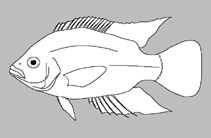
Espinas dorsales (total) : 15 - 17; Radios blandos dorsales (total) : 8; Espinas anales: 3; Radios blandos anales: 7 - 8; Vértebra: 26. Distinguished from all congeners, among other characters, by approximately equal uncinate process and anterior arm and reduced anteroventral expansion of epibranchial 1 (vs. uncinate process narrower and complete anteroventral expansion in the other two species), a dorso-ventrally flattened maxillary process of the palatine (vs. cylindrical in the other two species), cycloid (vs. ctenoid) scales in the opercular, postorbital, lateral chest and anal-genital regions, the absence of a mid-lateral spot, and a diffuse dark area covering the dorsal portion of the head giving the impression of a 'black cap'. Possessess a unique juvenile pattern of seven vertical dark bars partially preserved in adults. Bars 3-6 in antero-caudal direction are most visible in juveniles and medium-sized specimens but become fainter and almost disappear in adults. Many specimens show only bar number 3 (midlateral bar) (Ref. 91746).
Abundant in the entire upper Mazaruni River basin, and especially in tributaries with rocky substrates and rich in rapids. Collected from black water sites with fairly high transparency (0.55-1.0 m Secchi depth), none to relatively fast currents (0-0.6 m/s), temperature (21.7- 24.5°C), pH (4.4-4.8), dissolved oxygen (5.2- 9.3 mg/L) and very low conductivity (<10 µS). Ref. 91746).
Ciclo vital y comportamiento de apareamiento
Madurez | Reproducción | Puesta | Huevos | Fecundidad | Larva
López-Fernández, H., D.C. Taphorn and E.A. Liverpool, 2012. Phylogenetic diagnosis and expanded description of the genus Mazarunia Kullander, 1990 (Teleostei: Cichlidae) from the upper Mazaruni River, Guyana, with description of two new species. Neotrop. Ichthyol. 10(3):465-486. (Ref. 91746)
Situación en la Lista Roja de la UICN (Ref. 130435: Version 2025-2 (Global))
Amenaza para el ser humano
Harmless
Usos humanos
Herramientas
Informes especiales
Descargar XML
Fuentes de Internet
Estimaciones basadas en modelos
Índice de diversidad filogenética (Referencia
82804): PD
50 = 0.6250 [Uniqueness, from 0.5 = low to 2.0 = high].
Bayesian length-weight: a=0.03020 (0.01328 - 0.06866), b=3.03 (2.84 - 3.22), in cm total length, based on LWR estimates for this (Sub)family-body shape (Ref.
93245).
Nivel trófico (Referencia
69278): 3.2 ±0.5 se; based on size and trophs of closest relatives
Vulnerabilidad pesquera (Ref.
59153): Low vulnerability (10 of 100).
🛈