التصنيف / الأسماء
الأسماء الشائعة | مرادفات | Catalog of Fishes(جنس, الانواع) | ITIS | CoL | WoRMS | Cloffa
>
Siluriformes (Catfishes) >
Trichomycteridae (Pencil or parasitic catfishes) > Microcambevinae
Etymology: Listrura: Greek, listroo = to tie + Greek, oura = tail (Ref. 45335); costai: Named for for Dr. Wilson J. E. M. Costa, in recognition of his significant contributions to Neotropical Ichthyology, including the study with trichomycterid catfishes.
Eponymy: Dr Wilson Jose Eduardo Moreira da Costa is a Brazilian biologist and ichthyologist. [...] (Ref. 128868), visit book page.
البيئة: الوسط / المنطقة المناخية / نطاق العمق / نطاق التوزيع
البيئة
; المياه العذبة القاع; pH range: 6.1 - ?. Tropical; 26°C - ? (Ref. 91744)
South America: two small unnamed coastal streams draining into a swampy portion of the rio Jurumirim, close to its mouth, in Rio de Janeiro State, Brazil.
الحجم / وزن / العمر
النضج: Lm ? range ? - ? cm
Max length : 3.4 cm SL ذكر/ مختلط الجنس; (Ref. 91744)
وصف مختصر
مفاتيح التعريف | الوصف الخارجي | قياسات المظهر الخارجي
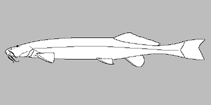
الأشعة الظهرية الناعمة (المجموع) : 8 - 9; أشعه شرجية لينه: 8 - 9; فقرات: 48 - 52. Distinguished from its congeners by having a small anterior process on the first hypobranchial (vs. process absent). Differs also from its congeners, except Listrura nematopteryx and Listrura picinguabae, by having only one ray on pectoral fin (vs. two to four rays). It can be separated from Listrura nematopteryx and Listrura picinguabae by having an inferior row of dots extending only on posterior half of body (vs. over almost the entire body), and posterior tip of ceratobranchial 5 strongly concave (vs. slightly concave or straight. Can be further distinguished from Listrura nematopteryx by having a discontinuous lateral midline row of spots (vs. continuous row), lateral processes of urohyal reaching the anterior region of posterior ceratohyal [vs. reaching the posterior region of posterior ceratohial; more dorsal and anal-fin rays (8-9 vs. 7-8 and 8-9 vs. 6-8, respectively), and more opecular and interopercular odontodes (6-8 vs. 4-6 and 8-12 vs. 5-7 respectively); from Listrura picinguabae by possessing a longer head (head length 11.7-15.3% SL vs. 10.7- 11.7% SL), more dorsal-fin rays (8-9 vs. 7), and anal-fin origin at vertical through region from centra of the 31st to 34th vertebrae (vs. 34th to 36th) (Ref. 91744).
Body shape (shape guide): elongated.
Found mostly in narrow (about 1 m wide) and shallow (about 50 cm deep) clear water stream located in a swampy plain area densely vegetated with grass. Captured at night or dusk, suggesting a nocturnal habit (Ref. 91744).
دورة الحياة وسلوك التزاوج
النضج | التكاثر | وضع البيض | بيض | الخصوبة | اليرقات
Villa-Verde, L., H. Lazzarotto and S.M.Q. Lima, 2012. A new glanapterygine catfish of the genus Listrura (Siluriformes: Trichomycteridae) from southeastern Brazil, corroborated by morphological and molecular data. Neotrop. Ichthyol. 10(3):527-538. (Ref. 91744)
حالة القائمة الحمراء للاتحاد الدولي لحفظ الطبيعة والموارد الطبيعية (Ref. 130435: Version 2025-2 (Global))
استخدامات بشرية
مصائد: غير ذات اهمية
أدوات
تقارير خاصة
تنزيل XML
مصادر علي الأنترنت
تقديرات تستند إلى النماذج
مؤشر التنوع الشُعبي الوراثي (مرجع
82804): PD
50 = 0.5005 [Uniqueness, from 0.5 = low to 2.0 = high].
Bayesian length-weight: a=0.00389 (0.00180 - 0.00842), b=3.12 (2.94 - 3.30), in cm total length, based on all LWR estimates for this body shape (Ref.
93245).
مستوى غذائي (مرجع
69278): 3.1 ±0.3 se; based on size and trophs of closest relatives
ضعف الصيد (Ref.
59153): Low vulnerability (10 of 100).
🛈