Classificação / Nomes
Nomes comuns | Sinônimos | Catalog of Fishes(Gênero, Espécies) | ITIS | CoL | WoRMS | Cloffa
>
Siluriformes (Catfishes) >
Loricariidae (Armored catfishes) > Hypostominae
Etymology: Peckoltia: Because of Gustavo Peckolt,member of the Natural History Commission of Rondon (Ref. 45335); simulata: Name from a Latin adjective simulata, meaning counterfeit, in reference to its similarity with Peckoltia oligospila.
Eponymy: Gustavo Peckolt (1861–1923) was a Brazilian-born German botanist and pharmacist. [...] (Ref. 128868), visit book page.
Meio ambiente: milieu / Zona climática / intervalo de profundidade / faixa de distribuição
Ecologia
; Água doce demersal; pH range: 6.1 - 6.2. Tropical; 25°C - 26°C (Ref. 90183)
South America: Oyapock River in French Guiana.
Tamanho / Peso / Idade
Maturidade: Lm ? range ? - ? cm
Max length : 8.3 cm SL macho/indeterminado; (Ref. 90183)
Descrição suscinta
Chaves de identificação | Morfologia | Morfometria
Espinhos dorsais (total) : 2; Raios dorsais (total) : 7; Espinhos anais: 1; Raios anais : 5. It is distinguished from other Guianese species by its specific barcode sequences (JF747001- JF747002) and from all congeners except Peckoltia oligospila, P. bachi,
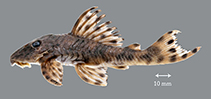
P. sabaji, P. otali and P. capitulata by having a spotted pattern of coloration of body including posterior part. It differs from the latter by teeth shape, with both lobes similar, long (unless if worn), lateral lobe being only very slightly smaller than medial lobe (vs. distinctly smaller). It can be diagnosed further from spotted species by having a longer hypertrophied cheek odontodes, longest one passing posterior end of cleithrum (vs. not reaching). It can be further separated from Peckoltia bachi and P. otali by rounded spotting (vs. mottling), from P. sabaji by smaller spots on caudal peduncle, and from P. capitulata by presence of spots on head (vs. absence). It differs further from P. oligospila by having a smaller body depth (19.8- 20.4% SL vs. 21.1-23.4), narrower body (29.5-30.7% SL vs. 30.9-32.8) and shorter orbital diameter (5.9-7.0% SL vs. 6.9-8.1) (Ref. 90183).
Body shape (shape guide): elongated.
Facultative air-breathing in the genus (Ref. 126274); Found in small forest creek tributaries on sandy and graveled bottom with rocks, woods and leaves (Ref. 90183). Collected with other species such as of Ancistrus cf. leucostictus, Ancistrus. aff. temminckii, Guyanancistrus longispinis, Farlowella reticulata, Rineloricaria stewarti, and Otocinclus mariae (Ref. 90183).
Ciclo de vida ou comportamento de acasalamento
Maturidade | Reprodução | Desova | Ovos | Fecundidade | Larvas
Fisch-Muller, S., J.I. Montoya-Burgos, P.-Y. Le Bail and R. Covain, 2012. Diversity of the Ancistrini (Siluriformes: Locariidae) from the Guianas: the Panaque group, a molecular appraisal with description of new species. Cybium 36(1):163-193. (Ref. 90183)
Status na Lista Vermelha da UICN (Ref. 130435: Version 2025-2 (Global))
Ameaça para os humanos
Harmless
Uso pelos humanos
Ferramentas
Relatórios especiais
Baixar XML
Fontes da internet
Estimativas baseadas em modelos
Índice de diversidade filogenética (Ref.
82804): PD
50 = 0.5000 [Uniqueness, from 0.5 = low to 2.0 = high].
Bayesian length-weight: a=0.01549 (0.00726 - 0.03306), b=2.96 (2.79 - 3.13), in cm total length, based on LWR estimates for this (Sub)family-body shape (Ref.
93245).
Vulnerabilidade da pesca (Ref.
59153): Low vulnerability (10 of 100).
🛈