Klassifizierung / Names
Namen | Synonyme | Catalog of Fishes(Gattung, Arten) | ITIS | CoL | WoRMS | Cloffa
>
Siluriformes (Catfishes) >
Loricariidae (Armored catfishes) > Loricariinae
Etymology: fluminensis: The specificn name 'fluminensis' is from the Latin flumen meaning river, in reference to the ecology of Harttia that represents a group of rheophilic fish from the main channel of rivers.
Eponymy: Charles Frederick Hartt (1840–1878) was a Canadian geologist, palaeontologist and naturalist, who was a member of the Thayer Expedition (1865–1866) to Brazil, a country in which he was a specialist. [...] (Ref. 128868), visit book page.
Umwelt: Milieu / Klimazone / Tiefenbereich / Verbreitungsgebiet
Ökologie
; süßwasser demersal. Tropical
South America: Known only from the Coppename River drainage in Suriname.
Größe / Gewicht / Alter
Geschlechtsreife: Lm ? range ? - ? cm
Max length : 15.1 cm SL Männchen/unbestimmt; (Ref. 90209)
Kurzbeschreibung
Bestimmungsschlüssel | Morphologie | Morphometrie
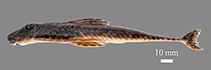
Rückenflossenweichstrahlen (insgesamt) : 7; Afterflossenstacheln: 1; Afterflossenweichstrahlen: 5. Distinguished from all other species of the genus Harttia except Harttia tuna and Harttia trombetensis by having an incomplete abdominal cover, restricted to preanal and abdominal lateral plates with a row of platelets joining these two series of plates (vs. absence of row of platelets making junction between preanal and lateral abdominal plates), and by its specific barcode sequence (JF292263). Differs from Harttia tuna by having a deeper head (37.31-43.30, mean 38.94 ± 1.42% of HL, vs 31.96-38.77, mean 36.52 ± 1.80% of HL), and from Harttia trombetensis by its color pattern of caudal fin (a large dark band at base of caudal fin vs. a dark rounded blotch). Can be further diagnosed from all other congeners by having a greater minimum caudal peduncle depth (mean = 1.60 ± 0.11% of SL vs. 1.35 ± 0.13 < mean < 1.43 ±0.11% of SL); and a greater interorbital width (mean = 24.25 ±1.02% of HL vs. 22.04 ± 1.27 < mean < 23.12 ± 1.11% of HL) (Ref. 90209).
Body shape (shape guide): elongated.
Frequents main channel over rocky and sandy bottom in fast flowing waters (Ref. 90209).
Lebenszyklus und Paarungsverhalten
Geschlechtsreife | Fortpflanzung | Ablaichen | Eier | Fruchtbarkeit | Larven
Covain, R., S. Fisch-Muller, J.I. Montoya-Burgos, J.H. Mol, P.-Y. Le Bail and S. Day, 2012. The Harttiini (Siluriformes, Loricariidae) from the Guianas: a multi-table approach to assess their diversity, evolution, and distribution. Cybium 36(1):115-161. (Ref. 90209)
IUCN Rote Liste Status (Ref. 130435: Version 2025-2 (Global))
Bedrohung für Menschen
Harmless
Nutzung durch Menschen
Tools
Zusatzinformationen
Download XML
Internet Quellen
Schätzungen auf der Grundlage von Modellen
Phylogenetischer Diversitätsindex (Ref.
82804): PD
50 = 0.5000 [Uniqueness, from 0.5 = low to 2.0 = high].
Bayesian length-weight: a=0.00589 (0.00267 - 0.01297), b=3.07 (2.90 - 3.24), in cm total length, based on LWR estimates for this Genus-body shape (Ref.
93245).
Trophische Ebene (Ref.
69278): 2.5 ±0.2 se; based on size and trophs of closest relatives
Widerstandsfähigkeit (Ref.
120179): mittel, Verdopplung der Population dauert 1,4 - 4,4 Jahre. (Preliminary K or Fecundity.).
Anfälligkeit der Fischerei (Ref.
59153): Low vulnerability (10 of 100).
🛈