Ταξινόμηση / Ονόματα
Κοινά ονόματα | Συνώνυμα | Catalog of Fishes(Γένος, Είδη) | ITIS | CoL | WoRMS | Cloffa
>
Lophiiformes (Anglerfishes) >
Histiophrynidae (Starfingered frogfishes)
Etymology: Histiophryne: Greek, istion, istos = sail + Greek, phryne = toad (Ref. 45335); pogonia: The specific epithet pogonius alludes to the bearded appearance formed from the cutaneous cirri.
on the ventrolateral margins of the head (Ref. 89955).
Περιβάλλον: περιβάλλον / κλιματική ζώνη / εύρος βάθους / εύρος διανομής
Οικολογία
Θαλασσινό(ά) Υφαλόφιλο(α); εύρος βάθους 5 - ? m (Ref. 89955). Tropical
Pacific Ocean: Indonesia and Philippines. Known only from shallow inshore waters of Lombok I. and Komodo I., Indonesia, and perhaps nearshore waters surrounding Cebu I., Philippines (Ref. 89955).
Μέγεθος / Βάρος / Ηλικία
Γεννητική Ωρίμανση: Lm ? range ? - ? cm
Max length : 4.8 cm SL αρσενικό/απροσδιόριστο; (Ref. 89955); 5.4 cm SL (female)
Σύντομη περιγραφή
Κλείδες προσδιορισμού | Μορφολογία | Μορφομετρία
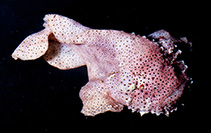
Μαλακές ραχιαίες ακτίνες (συνολικά) : 13 - 14; Μαλακές εδρικές ακτίνες: 7; Σπόνδυλοι: 20. This species is distinguished by having the entire body, including the lips and outer margins of the sclera, covered with small dark reddish to black spots encircled with a white ring; cheeks with numerous small shallow depressions, giving a pitted appearance to the head; an extremely small illicium and esca, barely discernible even with aid of a dissecting microscope; dark pink pigmentation overlaying a pale pink background, including a dark pink basidorsal spot; a small white encrusted patch of skin (resembling coralline algae) always present posterior to pectoral-fin origin, sometimes present on cheeks; head lightly covered with cutaneous cirri, especially around edges of opercle; upper and lower lips with short cutaneous cirri (Ref. 89955).
Body shape (shape guide): short and / or deep; Cross section: angular.
This species appears to occur within reef habitat and may be more active at night. Two procured specimens were observed to live peacefully together in an aquarium for many months (suggesting that Histiophryne may not be cannibalistic or as aggressive as Antennarius and Histrio) (Ref. 89955).
Κύκλος ζωής και συμπεριφορά ζευγαρώματος
Γεννητική Ωρίμανση | Αναπαραγωγή | Γεννοβολία | Αβγά | Γονιμότητα | Προνύμφες
Arnold, R.J., 2012. A new species of frogfish of the genus Histiophryne (Teleostei: Lophiiformes: Antennariidae) from Lombok and Komodo, Indonesia. Zootaxa 3253:62-68. (Ref. 89955)
Κατάσταση Κόκκινου Καταλόγου IUCN (Ref. 130435: Version 2025-2 (Global))
Απειλή για τον άνθρωπο
Harmless
Ανθρώπινες χρήσεις
Εργαλεία
Ειδικές εκθέσεις
Λήψη XML
Διαδικτυακές πηγές
Εκτιμήσεις βάσει μοντέλων
Δείκτης φυλογενετικής ποικιλότητας (Αναφ.
82804): PD
50 = 0.5313 [Uniqueness, from 0.5 = low to 2.0 = high].
Bayesian length-weight: a=0.01995 (0.00906 - 0.04395), b=3.01 (2.83 - 3.19), in cm total length, based on all LWR estimates for this body shape (Ref.
93245).
Τροφικό Επίπεδο (Αναφ.
69278): 3.5 ±0.5 se; based on size and trophs of closest relatives
Ευπάθεια στην αλιεία (Ref.
59153): Low vulnerability (10 of 100).
🛈