Klassifizierung / Names
Namen | Synonyme | Catalog of Fishes(Gattung, Arten) | ITIS | CoL | WoRMS | Cloffa
>
Siluriformes (Catfishes) >
Clariidae (Airbreathing catfishes)
Etymology: Tanganikallabes: Composed from lake Tanganyka + Greek, allabes, -etos = a fish of the Nile, a kind of lamprey (Ref. 45335); stewarti: The specific epithet of this species is a patronym in honour of American ichthyologist Donald J. Stewart, who collected the holotype and other material used in the description of this species, as well as assisting in the collection of much of the type series of Tanganikallabes alboperca (Ref. 90118).
Eponymy: Dr Donald James Stewart (d: 1946) is Professor of Environment & Forest Biology at the College of Environmental Science and Forestry, State University of New York, Syracuse, where he presently teaches Ichthyology & Tropical Ecology. [...] (Ref. 128868), visit book page.
Umwelt: Milieu / Klimazone / Tiefenbereich / Verbreitungsgebiet
Ökologie
; süßwasser benthopelagisch. Tropical
Africa: Lake Tanganyika (Ref. 90118).
Größe / Gewicht / Alter
Geschlechtsreife: Lm ? range ? - ? cm
Max length : 15.5 cm SL Männchen/unbestimmt; (Ref. 90118)
Kurzbeschreibung
Bestimmungsschlüssel | Morphologie | Morphometrie
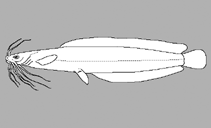
Rückenflossenstacheln (insgesamt) : 0; Rückenflossenweichstrahlen (insgesamt) : 72 - 79; Afterflossenstacheln: 0; Afterflossenweichstrahlen: 63 - 69. Diagnosis: Tanganikallabes stewarti is distinguished from all congeners by having an incomplete lateral line, which terminates at a vertical through a point approximately two-thirds of the distance along the anal fin base, vs. lateral line reaching the caudal peduncle in T. mortiauxi and extending much closer to the caudal peduncle in T. alboperca ; and by its relatively shallower body, body depth at anus 8.7-10.9% of standard length vs. 12.3-17.2% in T. mortiauxi and 11.7-14.6% in T. alboperca (Ref. 90118). Tanganikallabes stewarti is further separated from T. mortiauxi by its premaxillary toothpad shape, uniformly thin, broad crescent, vs. widest point anteroposteriorly thicker; lack of a free lower orbital margin; io-iv and the suprapreopercle consisting of multiple separate elements, vs. a single element; the extensions of the lateral ethmoid not reaching io-ii when viewed from above, vs. nearly or completely overlaying io-ii; its proportionally shorter prepelvic length, 35.7-39.2% of standard length vs. 39.7-44.4%; its proportionally shorter preanal length, 42.4-44.8% of standard length vs. 47.1-51.7%; longer anal fin, anal fin base 54.1-58.9% of standard length vs. 47.6-54.2% (Ref. 90118). It can additionally be distinguished from T. alboperca by its lack of a depigmented opercular margin; having longer pelvic fins, 7.1-9.3% of standard length vs. 6.0-7.7%, which reach beyond the origin of the anal fin when adpressed; proportionately longer pectoral fin spines, 5.0-6.8% of standard length vs. 3.6-5.3%; a shorter preanal length, 42.4-44.8% of standard length vs. 45.2-49.0%; and a generally higher number of dorsal fin rays, 72-79 vs. 65-74, and anal fin rays, 63-69 vs. 55-63 (Ref. 90118).
Body shape (shape guide): elongated.
It is likely to inhabit rocky bottoms, over a range of depths (Ref. 90118).
Lebenszyklus und Paarungsverhalten
Geschlechtsreife | Fortpflanzung | Ablaichen | Eier | Fruchtbarkeit | Larven
Wright, J.J. and R.M. Bailey, 2012. Systematic revision of the formerly monotypic genus Tanganikallabes (Siluriformes: Clariidae). Zool. J. Linn. Soc. 165:121-142. (Ref. 90118)
IUCN Rote Liste Status (Ref. 130435: Version 2025-2 (Global))
Bedrohung für Menschen
Harmless
Nutzung durch Menschen
Tools
Zusatzinformationen
Download XML
Internet Quellen
Schätzungen auf der Grundlage von Modellen
Phylogenetischer Diversitätsindex (Ref.
82804): PD
50 = 0.6250 [Uniqueness, from 0.5 = low to 2.0 = high].
Bayesian length-weight: a=0.00741 (0.00344 - 0.01597), b=2.97 (2.79 - 3.15), in cm total length, based on LWR estimates for this (Sub)family-body shape (Ref.
93245).
Trophische Ebene (Ref.
69278): 3.4 ±0.6 se; based on size and trophs of closest relatives
Widerstandsfähigkeit (Ref.
120179): hoch, Verdopplung der Population dauert weniger als 15 Monate. (Preliminary K or Fecundity.).
Anfälligkeit der Fischerei (Ref.
59153): Low vulnerability (10 of 100).
🛈