Classification / Noms
Noms communs | Synonymes | Catalog of Fishes(Genre, Espèce) | ITIS | CoL | WoRMS | Cloffa
>
Kurtiformes (Nurseryfishes, cardinalfishes.) >
Apogonidae (Cardinalfishes) > Apogoninae
Etymology: Siphamia: A Swazi word, siphama, for a fish; senoui: This species is named senoui in honour of Dr. Hiroshi Senou of the Kanagawa Prefectural Museum of Natural History. Dr. Senou, in collaboration with various Japanese colleagues, has been largely responsible for a marked increase in our knowledge of tropical reef fishes occurring in southern Japan and the adjacent Ryukyu Archipelago. He also collected and photographed the holotype and most paratypes of this species. (Ref. 90035).
Eponymy: Dr Hiroshi Senou of the Division of Fishes, Kanagawa Prefectural Museum of Natural History, has been a leader in the drive to find more about the tropical reef fishes occurring in southern Japan and the adjacent Ryukyu Archipelago. [...] (Ref. 128868), visit book page.
Environnement : milieu / zone climatique / profondeur / gamme de distribution
Écologie
marin benthopélagique; profondeur 10 - 35 m (Ref. 90035). Tropical
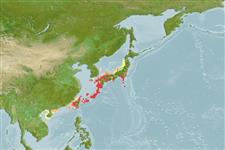
Pacific Ocean: Japan (Ref. 90035)
Taille / Poids / Âge
Maturité: Lm ? range ? - ? cm
Max length : 1.9 cm SL (female)
Description synthétique
Clés d'identification | Morphologie | Morphométrie
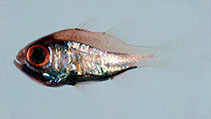
Dorsal rays VII+I,9; anal rays II,8; pectoral rays 12 (rarely 11 or 13); tubed lateral-line scales 3-8; median predorsal scales 4-5; total gill rakers 3-4 + 9-11 = 12-14; developed gill rakers 1-2 + 8-9; gill rakers on ceratobranchial 6-7. Body depth 2.3-2.7 in SL and body width 1.95-2.25 in the depth; eye diameter 2.65-3.1 in head length; first dorsal spine 2.3-10.3 in second spine; second dorsal spine 4.35-6.2, spine of second dorsal fin 3.5-4.4,and second anal spine 4.7-5.6, all in head length; pectoral-fin length 4.4-4.95 and pelvic-fin length 4.1-4.9 in SL;caudal-peduncle length 1.1-1.5 in distance between pelvic spine insertion and anal-fin origin. Preopercular edgeweakly serrate around angle, with 4-15 (usually 7-12) minute serrations; preopercular ridge smooth. Tip of light organon each side of tongue bound by membrane (Ref. 90035).
Body shape (shape guide): short and / or deep.
Cycle de vie et comportement reproducteur
Maturité | Reproduction | Frai | Œufs | Fécondité | Larves
Gon, O. and G.R. Allen, 2012. Revision of the Indo-Pacific cardinalfish genus Siphamia (Perciformes: Apogonidae). Zootaxa 3294:1-84. (Ref. 90035)
Statut dans la liste rouge de l'IUCN (Ref. 130435: Version 2025-2 (Global))
Menace pour l'homme
Harmless
Utilisations par l'homme
Outils
Articles particuliers
Télécharger en XML
Sources Internet
Estimations basées sur des modèles
Indice de diversité phylogénétique (Réf.
82804): PD
50 = 0.5000 [Uniqueness, from 0.5 = low to 2.0 = high].
Bayesian length-weight: a=0.01514 (0.00700 - 0.03275), b=3.07 (2.89 - 3.25), in cm total length, based on LWR estimates for this (Sub)family-body shape (Ref.
93245).
Niveau trophique (Réf.
69278): 3.0 ±0.4 se; based on size and trophs of closest relatives
Résilience (Réf.
120179): Haut, temps minimum de doublement de population inférieur à 15 mois (Preliminary K or Fecundity.).
Vulnérabilité de la pêche (Ref.
59153): Low vulnerability (10 of 100).
🛈