Environnement : milieu / zone climatique / profondeur / gamme de distribution
Écologie
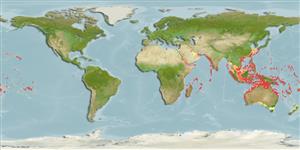
marin; saumâtre récifal; profondeur 0 - 80 m (Ref. 9710). Tropical; 32°N - 47°S, 24°E - 140°W
Indo-Pacific: Persian Gulf (Ref. 68964), Red Sea and East Africa to the Marquesan and Easter islands, north to southern Japan and the Ogasawara Islands, south to northern Australia and Lord Howe Island; except in Hawaii, where former subspecies C. marginatus is found.
Taille / Poids / Âge
Maturité: Lm ? range ? - ? cm
Max length : 140 cm TL mâle / non sexé; (Ref. 90102); common length : 50.0 cm TL mâle / non sexé; (Ref. 11039)
Description synthétique
Clés d'identification | Morphologie | Morphométrie
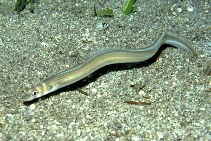
Épines dorsales (Total) : 0; Épines anales: 0; Vertèbres: 139 - 146. Flanges on upper and lower lips well developed; 2 rows of teeth in jaws, those of outer row larger; closely set and compressed to form cutting edge; 6th infraorbital pore located close behind and slightly above posterior angle of jaw. Dorsal fin begins over middle of appressed pectoral fin (Ref. 11039, refer to key for other characters). Brownish grey, yellow below and on fins, median fins with narrow black edge, black patch on lower rear edge of eye and on pectorals (Ref. 5323); assumes a pattern of broad dark bands at night (see also Ref. 4538, 1602). Body depth at gill opening 17-23 in TL (Ref. 90102).
Body shape (shape guide): eel-like; Cross section: circular.
Solitary species common on reef flats and seagrass beds of shallow lagoons but ranges to depths of 80 m on outer reef slopes (Ref. 1602). Also found in estuaries (Ref. 5213). Feeds on fish and crustaceans at night, assuming a pattern of broad dark grey bars (Ref. 11441). Minimum depth reported taken from Ref. 86942.
Cycle de vie et comportement reproducteur
Maturité | Reproduction | Frai | Œufs | Fécondité | Larves
Smith, D.G., 1999. Congridae. Conger eels. p. 1680-1686. In K.E. Carpenter and V.H. Niem (eds.) FAO species identification guide for fishery purposes. The living marine resources of the WCP. Vol. 3. Batoid fishes, chimaeras and bony fishes part 1 (Elopidae to Linophrynidae). FAO, Rome. (Ref. 11039)
Statut dans la liste rouge de l'IUCN (Ref. 130435: Version 2025-2 (Global))
Menace pour l'homme
Harmless
Utilisations par l'homme
Pêcheries: commercial; pêche sportive: oui; Aquarium: Commercial
Outils
Articles particuliers
Télécharger en XML
Sources Internet
Estimations basées sur des modèles
Température préférée (Réf.
123201): 23.7 - 29, mean 27.7 °C (based on 1436 cells).
Indice de diversité phylogénétique (Réf.
82804): PD
50 = 0.5000 [Uniqueness, from 0.5 = low to 2.0 = high].
Bayesian length-weight: a=0.00059 (0.00034 - 0.00103), b=3.21 (3.06 - 3.36), in cm total length, based on LWR estimates for this species & Genus-body shape (Ref.
93245).
Niveau trophique (Réf.
69278): 4.3 ±0.5 se; based on diet studies.
Résilience (Réf.
120179): Faible, temps minimum de doublement de population : 4,5 à 14 années (Preliminary K or Fecundity.).
Vulnérabilité de la pêche (Ref.
59153): Very high vulnerability (84 of 100).
🛈
Nutriments (Ref.
124155): Calcium = 22.3 [12.3, 38.1] mg/100g; Iron = 0.449 [0.264, 0.796] mg/100g; Protein = 19.1 [16.1, 22.1] %; Omega3 = 0.114 [0.052, 0.326] g/100g; Selenium = 49.9 [26.8, 95.7] μg/100g; VitaminA = 67.3 [20.5, 229.8] μg/100g; Zinc = 0.8 [0.6, 1.1] mg/100g (wet weight);