Classificazione / Nomi
Nomi Comuni | Sinonimi | Catalog of Fishes(Genere, Specie) | ITIS | CoL | WoRMS | Cloffa
>
Perciformes/Percoidei (Perchs) >
Percidae (Perches) > Etheostomatinae
Etymology: Etheostoma: Greek, etheo = to strain + Greek, stoma = mouth; Rafinesque said "various mouths", but Jordan and Evermann suggest the name might have been intended as "Heterostoma (Ref. 45335); maydeni: The name maydeni is in honor of Dr. Richard L. Mayden, a prominent ichthyologist, mentor and friend of the authors. His studies of North American fishes include ecology, biogeography, conservation, and systematics. The common name "Redlips Darter" refers to the conspicuous red pigment on the surface of the flesh surrounding the premaxilla and mandible often referred to as lips (Ref. 89958).
Eponymy: Dr Richard Lee Mayden (d: 1955) is an American ichthyologist and systematic biologist. [...] (Ref. 128868), visit book page.
Ambiente: milieu / zona climatica / distribuzione batimetrica / gamma di distribuzione
Ecologia
; acqua dolce demersale, usually 0 - 1 m (Ref. 89958). Subtropical; 37°N - 36°N, 84°W - 85°W
North America: restricted to large tributaries of the Cumberland River below Cumberland Falls, USA.
Dimensione / Peso / Età
Maturità: Lm ? range ? - ? cm
Max length : 8.0 cm SL maschio/sesso non determinato; (Ref. 89958)
Breve descrizione
Chiavi di identificazione | Morfologia | Morfometria
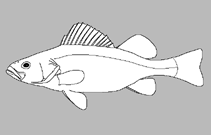
The Etheostoma cinereum complex is diagnosed from all other darters by having the combination of an elongated, pointy snout, rust to faint red spots in 4 horizontal rows dorsolaterally on the side of the body, dark brown to black oval to rectangular lateral blotches expanding to faint diagonal bands on the side of the body, red pigment on interradial membranes of the soft dorsal fin, and a distal red band of pigment in the spinous dorsal fin. For further diagnoses of this complex (a.k.a. subgenus Allohistium), see Bailey & Gosline (1955) and Page (1981). Etheostoma maydeni is distinguished from E. cinereum by a conspicuous red pigment on the external surface of the lips. Etheostoma maydeni also has modally 11 dorsal spines, 12 dorsal rays, and 23 caudal peduncle scales, whereas E. cinereum has modally 12 dorsal spines, 13 dorsal rays, and 25 caudal peduncle scales. Shepard & Burr (1984) also reported modally 41 vertebrae in populations described herein as E. maydeni and with populations of E. cinereum having modally 42 or 43 vertebrae (Ref. 89958).
Body shape (shape guide): elongated.
Ciclo vitale e comportamento di accoppiamento
Maturità | Riproduzione | Deposizione | Uova | Fecondità | Larve
Powers, S.L., B.R. Kuhajda and S.E. Ahlbrand, 2012. Systematics of the Etheostoma cinereum (Teleostei: Percidae) species complex (subgenus Allohistium). Zootaxa 3277:43-55. (Ref. 89958)
Stato della Lista Rossa IUCN (Ref. 130435: Version 2025-2 (Global))
Minaccia per l'uomo
Harmless
Usi umani
Strumenti
Rapporti speciali
Scarica XML
Fonti Internet
Stime basate su modelli
Indice di diversità filogenetica (Fonte Biblio.
82804): PD
50 = 0.5000 [Uniqueness, from 0.5 = low to 2.0 = high].
Bayesian length-weight: a=0.00676 (0.00303 - 0.01510), b=3.12 (2.94 - 3.30), in cm total length, based on LWR estimates for this Genus-body shape (Ref.
93245).
Livello trofico (Fonte Biblio.
69278): 3.4 ±0.5 se; based on size and trophs of closest relatives
Resilienza (Fonte Biblio.
120179): Alto, tempo minimo di raddoppiamento della popolazione meno di 15 mesi (Preliminary K or Fecundity.).
Vulnerabilità della pesca (Ref.
59153): Low vulnerability (10 of 100).
🛈