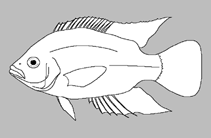
分类 / 名称
俗名 | 同种异名 | Catalog of Fishes(属, 种) | ITIS | CoL | WoRMS | Cloffa
Teleostei >
Cichliformes (Cichlids, convict blennies)
鱸形目 (Cichlids, convict blennies) >
Cichlidae (Cichlids)
麗魚科 (Cichlids) > Cichlinae
Etymology: Australoheros: From the Latin word 'australis' meaning southern, and the name Heros, after the nominotypic genus of the Heroini tribe.
Tribe; tavaresi: Named for Felipe Tavares Autran, a student in Laboratório de Sistemática e Evolução de Peixes Teleósteos, Universidade Federal do Rio de Janeiro (UFRJ), Brazil, during the 1990’s. He first recognized this species as new in his unpublished monograph (Autran, 1995) on the "Cichlasoma" facetum species complex, under orientation of Wilson Costa. This study, although widely known among Brazilian ichthyologists, was never published (Ref. 89866).
Eponymy: Felipe Tavares Autran was a student when he first recognised this species as new, in his unpublished monograph (Autran, 1995) on the Cichlasoma facetum species complex. [...] (Ref. 128868), visit book page.
环境:氛围 / 气候带 / 深度上下限 / 分布范围
生态学
; 淡水 大洋性.
South America: Upper rio Tietê drainage, upper rio Paraná basin in São Paulo, Brazil.
大小 / 重量 / 年龄
成熟度: Lm ? range ? - ? cm
Max length : 7.9 cm SL 雄鱼/尚未辨别雌雄; (Ref. 89866)
简单描述
检索表 | 型态特徵 | 形态测量图
背棘 (总数) : 16 - 17; 背的软条 (总数) : 10 - 11; 臀棘: 7 - 8; 臀鳍软条: 8 - 9; 脊椎骨: 26. Distinguished from all other species of Australoheros (except A. facetus) by having prognathous mouth (vs. isognathous); from species of the A. facetus, A. forquilha, A. kaaygua and A. scitulus species groups, and from A. acaroides, A. ykeregua, A. angiru and A. taura by having 12 caudal vertebrae (vs. 13 - 15) and 14 precaudal vertebrae (vs. 12 - 13); from species of the A. facetus, A. forquilha and A. kaaygua species groups by having three abdominal bars in all stages of life (vs. always four abdominal bars in juveniles, and adults with three bars in about 50% and four in about 50% of all specimens examined); from A. perdi by having 26 total vertebrae (vs. 25); from A. ykeregua by the absence of dark marks on the suborbital region (vs. presence); from A. agiru by having a conspicuous rounded caudal-fin base spot (vs. spot very narrow or absent); from all its congeners of the A. autrani species group (except A. mattosi and A. montanus) by having a fewer body depth (39.0 - 42.2% SL in A. tavaresi vs. 45.7 - 50.9% SL in A. autrani, 44.6 - 49.0% SL in A. barbosae, 47.3 - 51.2% SL in A. ipatinguensis, 46.6 - 49.8% SL in A. macacuensis, 44.0 - 48.2% SL in A. macaensis, 43.8 - 50.1% SL in A. muriae, 42.6 - 46.1% SL in A. paraibae, 47.4 - 51.3% SL in A. ribeirae, 43.7 - 46.0% SL in A. robustus, 44.0 - 48.2% SL in A. saquarema, 42.6 - 50.3% SL in A. capixaba); from A. saquarema, A. muriae, A. robustus, A. barbosae, A. macacuensis, A. ipatinguensis, A. paraibae and A. ribeirae by having a longer caudal peduncle (caudal peduncle length 9.8 - 11.6% SL in A. tavaresi vs. 6,6 - 8,0% SL in A. ipatinguensis, 6.7 - 9.0% SL in A. saquarema, 5.1 - 7.9% SL in A. macacuensis, 5.5 - 8.7% SL in A. barbosae, 7.1 - 8.9% SL in A. muriae, 6.4 - 8.1% SL in A. paraibae, 7.4 - 9.2% SL in A. robustus and 6.6 - 9.1% SL in A. ribeirae); from A. barbosae, A. macacuensis, A. paraibae, A. ribeirae and A. saquarema by having a fewer preorbital depth (51.2 - 60.0 % SL in A. tavaresi vs. 60.5 - 65.3% SL in A. barbosae, 62.2 - 65.4% SL in A. macacuensis, 60.4 - 65.2% SL in A. paraibae, 64.2 - 73.3% SL in A. ribeirae, 66.0 - 69.1% SL in A. saquarema); from A. macacuensis and A. montanus sp. n. by having arms of trunk bar 7 with the same width (vs. posterior arm of trunk bar 7 wider than anterior one); from A. mattosi by having anal-fin base squamation beginning at the sixth anal-fin spine (vs. anal-fin base squamation beginning at the third anal-fin spine); and from A. ribeirae by having a fewer head depth (head depth 80.6 - 94.2% HL vs. 95.4 - 98.9% HL) (Ref. 89866).
生命周期和交配行为
成熟度 | 繁殖 | 产卵场 | 卵 | 孕卵数 | 仔鱼
Ottoni, F.P., 2012. Three new species of Australoheros from southeastern Brazil, with taxonomic notes on Chromys oblonga, Heros autochton and H. jenynsii (Teleostei: Labroidei: Cichlidae). Vertebrate Zoology 62(1):83-96. (Ref. 89866)
世界自然保护联盟红皮书 (Ref. 130435: Version 2025-2 (Global))
人类利用
工具
特别资料
下载 XML
网络资源
基于模型的估算
系统发育多样性指数 (参考文献
82804): PD
50 = 0.5000 [Uniqueness, from 0.5 = low to 2.0 = high].
Bayesian length-weight: a=0.01445 (0.00665 - 0.03141), b=3.08 (2.90 - 3.26), in cm total length, based on LWR estimates for this (Sub)family-body shape (Ref.
93245).
营养阶层 (参考文献
69278): 3.2 ±0.5 se; based on size and trophs of closest relatives
渔业脆弱性 (Ref.
59153): Low vulnerability (10 of 100).
🛈