Élasmobranches (requins et raies) (sharks and rays) >
Squaliformes (Sleeper and dogfish sharks) >
Somniosidae (Sleeper sharks)
Etymology: Scymnodon: scymnus, an ancient name for some kind of shark, derived from a Greek word meaning young animal, cub or whelp; odon (Gr.), tooth, referring to large, triangular cutting teeth on lower jaw of S. ringens (See ETYFish); macracanthus: macro-, from makros (Gr.), long or large; acanthus (L.), from akantha (Gr.), thorn, referring to stout, prominent dorsal-fin spines (See ETYFish).
More on author: Regan.
Environnement : milieu / zone climatique / profondeur / gamme de distribution
Écologie
marin bathydémersal; profondeur 219 - 1550 m (Ref. 6871), usually 550 - 732 m (Ref. 247). Deep-water; 50°S - 54°S
Indo-Pacific: southern distribution, discontinuous across Pacific and Indian Oceans.
Longueur à la première maturité / Taille / Poids / Âge
Maturité: Lm 149.5, range 129 - 170 cm
Max length : 131 cm TL mâle / non sexé; (Ref. 247); 170.0 cm TL (female)
Description synthétique
Clés d'identification | Morphologie | Morphométrie
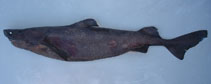
Épines dorsales (Total) : 2; Épines anales: 0. Dark brown or blackish in color, dorsal fins with fairly prominent fin spines, moderately long snout, lanceolate upper teeth and bladelike lower teeth with short, oblique cusps, stocky body that tapers abruptly from pectoral region, and moderately large tricuspidate and tricarinate lateral trunk denticles (Ref. 247).
Body shape (shape guide): elongated.
A rare species inhabiting lower continental slopes (Ref. 26346), also on insular slopes in large schools near the bottom which are segregated according to size and sex, and feeds on cephalopods and bony fishes (Ref. 247). Up to 36 young in a litter, ths size at birth between 32 and 36 cm (Ref. 247). Used for fishmeal and liver oil (Ref. 6871). Minimum depth from Ref. 247. Ovoviviparous (Ref. 205).
Cycle de vie et comportement reproducteur
Maturité | Reproduction | Frai | Œufs | Fécondité | Larves
Ovoviviparous (Ref. 26346). Distinct pairing with embrace (Ref. 205).
Compagno, L.J.V., 1984. FAO Species Catalogue. Vol. 4. Sharks of the world. An annotated and illustrated catalogue of shark species known to date. Part 1 - Hexanchiformes to Lamniformes. FAO Fish. Synop. 125(4/1):1-249. Rome, FAO. (Ref. 247)
Statut dans la liste rouge de l'IUCN (Ref. 130435: Version 2025-2 (Global))
Menace pour l'homme
Harmless
Utilisations par l'homme
Pêcheries: sans intérêt
Outils
Articles particuliers
Télécharger en XML
Sources Internet
Estimations basées sur des modèles
Indice de diversité phylogénétique (Réf.
82804): PD
50 = 0.6250 [Uniqueness, from 0.5 = low to 2.0 = high].
Bayesian length-weight: a=0.00380 (0.00228 - 0.00633), b=3.11 (2.97 - 3.25), in cm total length, based on LWR estimates for this species & (Sub)family-body (Ref.
93245).
Niveau trophique (Réf.
69278): 4.5 ±0.59 se; based on food items.
Résilience (Réf.
120179): Faible, temps minimum de doublement de population : 4,5 à 14 années (Fec assumed to be <100).
Vulnérabilité de la pêche (Ref.
59153): Very high vulnerability (90 of 100).
🛈