>
Gobiiformes (Gobies) >
Gobiidae (Gobies) > Gobiinae
Etymology: Eviota: No etymology given, suggested by Christopher Scharpt: from Latin 'eu' for 'true' and 'iota' for anything very small, in combination 'truly very small' referring to it as being the smallest vertebrate at the time it has benn described by Jenkins (thus, making the suggestion by Scharpt plausible; atriventris: The specific epithet is an adjective combining the Latin atrus (black) and venter (belly), referring to the black pigment in the area of the abdomen (Ref. 89418).
More on authors: Greenfield & Suzuki.
Entorno: milieu / zona climática / rango de profundidad / gama de distribución
Ecología
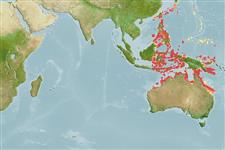
marino asociado a arrecife; rango de profundidad 3 - 20 m (Ref. 90102). Tropical; 31°N - 24°S, 116°E - 154°E
Pacific Ocean: Japan (southern Ryukyu Islands), Thailand, Brunei, Malaysia, Philippines, Palau, Indonesia (NW Kalimantan and Bali eastwards), Papua New Guinea, Solomon Islands, south to Australia (Great Barrier Reef) and east to New Caledonia.
Tamaño / Peso / Edad
Madurez: Lm ? range ? - ? cm
Max length : 1.7 cm SL macho / no sexado; (Ref. 89418)
Descripción breve
Claves de identificación | Morfología | Morfometría
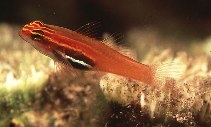
Espinas dorsales (total) : 7; Radios blandos dorsales (total) : 8 - 9; Espinas anales: 1; Radios blandos anales: 7 - 8. This species is distinguished from its congeners by the following set of characters: abdomen with black peritoneum, clearly visible externally; dorsal/anal formula 8/7; simple pectoral-fin rays; length of 5th pelvic-fin ray 40% or greater of 4th ray; genital papilla in male not fimbriate; cephalic sensory-pore system pattern group 2 (only IT missing) (Ref. 89418); characterized further by translucent red with pair of bright yellow stripe behind eye, lower stripe reaching midbody and upper nearly to caudal fin base; fins unmarked; longitudinal scale series 23-24; ctenoid scales, absent on head, nape and pectoral fin base; separated pelvic fins, thin membrane joining bases; 3-5 branches on fourth pelvic ray; depth of body 3.6-4.0 in SL (Ref. 90102).
Body shape (shape guide): elongated; Cross section: compressed.
Lives in small groups near Acropora colonies where it hides when threatened. Feeds on plankton(Ref. 89963). Sometimes solitary, frequently in shady spots near corals (Ref 90102).
Ciclo vital y comportamiento de apareamiento
Madurez | Reproducción | Puesta | Huevos | Fecundidad | Larva
Greenfield, D.W. and T. Suzuki, 2012. Eviota atriventris, a New Goby Previously Misidentified as Eviota pellucida Larson (Teleostei: Gobiidae). Zootaxa 3197:55-62. (Ref. 89418)
Situación en la Lista Roja de la UICN (Ref. 130435: Version 2025-2 (Global))
Amenaza para el ser humano
Harmless
Usos humanos
Herramientas
Informes especiales
Descargar XML
Fuentes de Internet
Estimaciones basadas en modelos
Temperatura preferida (Referencia
123201): 27.8 - 29.3, mean 28.7 °C (based on 946 cells).
Índice de diversidad filogenética (Referencia
82804): PD
50 = 0.5000 [Uniqueness, from 0.5 = low to 2.0 = high].
Bayesian length-weight: a=0.00692 (0.00281 - 0.01706), b=3.09 (2.92 - 3.26), in cm total length, based on LWR estimates for this Genus-body shape (Ref.
93245).
Nivel trófico (Referencia
69278): 3.0 ±0.3 se; based on size and trophs of closest relatives
Vulnerabilidad pesquera (Ref.
59153): Low vulnerability (10 of 100).
🛈
Nutrientes (Ref.
124155): Calcium = 585 [228, 2,435] mg/100g; Iron = 2.18 [0.79, 5.51] mg/100g; Protein = 17.4 [15.2, 19.5] %; Omega3 = 0.101 [0.026, 0.413] g/100g; Selenium = 42.2 [8.7, 166.6] μg/100g; VitaminA = 93.4 [13.2, 625.6] μg/100g; Zinc = 6.42 [2.99, 11.85] mg/100g (wet weight);