Classificazione / Nomi
Nomi Comuni | Sinonimi | Catalog of Fishes(Genere, Specie) | ITIS | CoL | WoRMS | Cloffa
>
Gobiiformes (Gobies) >
Gobiidae (Gobies) > Gobiinae
Etymology: discus: The species name discus is from the Latin meaning dish or dish-like, in reference to the flat pelvic fins of adults.
More on authors: Suzuki, Bogorodsky & Randall.
Ambiente: milieu / zona climatica / distribuzione batimetrica / gamma di distribuzione
Ecologia
marino associati a barriera corallina; distribuzione batimetrica 0 - 16 m (Ref. 89154). Tropical; 18°N - 17°N, 39°E - 40°E
Indian Ocean: known from specimens from the Suakin Archipelago off Sudan, and the Seven Brothers Islands (Sawabi Islands) in the Gulf of Aden near the southern end of the Red Sea (Ref. 89154).
Dimensione / Peso / Età
Maturità: Lm ? range ? - ? cm
Max length : 1.9 cm SL maschio/sesso non determinato; (Ref. 89154)
Breve descrizione
Chiavi di identificazione | Morfologia | Morfometria
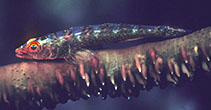
Dorsal-fin rays I,8; anal-fin rays I,9; pectoral-fin rays 14–15, some rays branched; scales on body reaching forward to or nearly to above base of pectoral fins, the longitudinal scale series 34–52, transverse scale rows 10–13; body very slender, the depth at anus 11–13% SL; head length 28–30% SL; head width slightly greater than head depth; head depth 43.5–50% head length; snout length 29–31% head length; jaws same length or lower jaw slightly protruding; lower jaw rounded in ventral view; gill opening wide, extending forward to below posterior edge of orbit; posterior interorbital pore (D) present; curved canine tooth at middle of side of lower jaw; pelvic fins flat and dish-like in adults (cup-like in 13.6-mm paratype); pelvic frenum with anteriorly-facing pocket; caudal fin truncate to rounded; numerous dark brown dots only on ventral half of body posterior to abdomen in preserved specimens; dorsal half of body transparent in life with seven saddle-like, pink and black bars (including one on nape), lower half of body pink, suffused with some yellow, and densely blotched and dotted with black. A small species, the holotype largest, 19.4 mm SL (Ref. 89154).
Body shape (shape guide): fusiform / normal.
Ciclo vitale e comportamento di accoppiamento
Maturità | Riproduzione | Deposizione | Uova | Fecondità | Larve
Suzuki, T., S.V. Bogorodsky and J.E. Randall, 2012. Gobiid fishes of the genus Bryaninops from the Red Sea, with description of two new species and two new records. Zootaxa 3170:1-17. (Ref. 89154)
Stato della Lista Rossa IUCN (Ref. 130435: Version 2025-2 (Global))
Minaccia per l'uomo
Harmless
Usi umani
Strumenti
Rapporti speciali
Scarica XML
Fonti Internet
Stime basate su modelli
Indice di diversità filogenetica (Fonte Biblio.
82804): PD
50 = 0.5000 [Uniqueness, from 0.5 = low to 2.0 = high].
Bayesian length-weight: a=0.01023 (0.00477 - 0.02194), b=3.01 (2.83 - 3.19), in cm total length, based on LWR estimates for this (Sub)family-body shape (Ref.
93245).
Livello trofico (Fonte Biblio.
69278): 3.0 ±0.3 se; based on size and trophs of closest relatives
Vulnerabilità della pesca (Ref.
59153): Low vulnerability (10 of 100).
🛈