This website uses cookies to enhance your browsing experience and ensure the functionality of our site. For more detailed information about the types of cookies we use and how we protect your privacy, please visit our Privacy Information page.
×
Cookie Settings
This website uses different types of cookies to enhance your experience. Please select your preferences below:
> Characiformes (Characins) > Alestidae (African tetras)
Etymology: Alestopetersius:Greek, a = without + Greek, lestes = thief + Peters, 1877, naturalist, expeditionary in Asia; conspectus:Conspectus, from the Latin, in reference to the conspicuous markings on the caudal fin and striking, bright coloration of the species in life (Ref. 89102).
背面の脊椎 (合計) : 0; 背鰭 (合計) : 10; 肛門の骨: 0; 臀鰭: 21 - 23; 脊つい: 36 - 37. Diagnosis: Alestopetersius conspectus, is distinguished from A. smykalai, A. leopoldianus, A. nigropterus, A. caudalis, and A. sp. "mbuji" in the possession of 12, vs. 10, circumpeduncular scales (Ref. 89102). It is readily distinguished from A. brichardi, A. compressus, A. hilgendorfi, and A. tumbensis in the possession of a caudal-fin pigmentation consisting of a median black band extending to the caudal-fin margin and flanked by dense black bands in both upper and lower fin lobes (Ref. 89102). Alestopetersius bifasciatus, which shares similar caudal fin pigmentation, is distinguished from A. conspectus by the absence of a broad mid-lateral band on the body, and in tooth morphology (Ref. 89102).
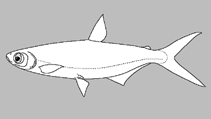
Body shape (shape guide): fusiform / normal.
Found in shallow water with water temperature of 21–21.5°C and pH ranging from 5.8–6.5; riverbanks variously covered with dense, undisturbed riparian vegetation, heavily degraded urban areas and cleared agricultural area (Ref. 89102). Short guts and large stomachs with 6-8 fleshy pyloric caeca suggest a carnivorous diet; stomachs with remnants of insect head capsules and disarticulated body parts, most of terrestrial origin, with a preponderance of ants and small midges presumably taken at the water surface (Ref. 89102).
Mbimbi Mayi Munene, J.J. and M.L.J. Stiassny, 2012. A new Alestopetersius (Characiformes: Alestidae) from the Kwilu River (Kasai basin) of central Africa; with a phylogeny for the genus and synonymy of Duboisialestes. Zootaxa 3166:59-68. (Ref. 89102)
IUCNのレッドリストの状況は (Ref. 130435: Version 2025-2 (Global))
系統多様性指数 (参照 82804): PD50 = 0.5002 [Uniqueness, from 0.5 = low to 2.0 = high].
Bayesian length-weight: a=0.01072 (0.00491 - 0.02339), b=3.02 (2.84 - 3.20), in cm total length, based on LWR estimates for this (Sub)family-body shape (Ref. 93245).
栄養段階 (参照 69278): 3.1 ±0.4 se; based on size and trophs of closest relatives
漁業の脆弱性 (Ref. 59153): Low vulnerability (10 of 100). 🛈