Taxonomic Remarks
FishBase common name changed from Ochrebanded goatfish to Ochre-banded goatfish (Uiblein et al., 2024: Ref. 130857).
Ambiente: milieu / zona climatica / distribuzione batimetrica / gamma di distribuzione
Ecologia
marino; salmastro demersale; distribuzione batimetrica 20 - 60 m (Ref. 83903). Tropical
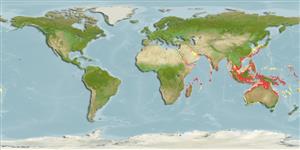
Indo-West Pacific: Pakistan, India and Sri Lanka, extending eastward to Indonesia. Recorded from the Gulf (Ref. 37588); also from northwestern Australia northward to Japan.
Dimensione / Peso / Età
Maturità: Lm ? range ? - ? cm
Max length : 22.0 cm TL maschio/sesso non determinato; (Ref. 3470); common length : 14.0 cm TL maschio/sesso non determinato; (Ref. 3470)
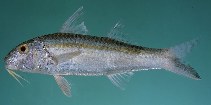
Spine dorsali (totale) : 8; Raggi dorsali molli (totale) : 9; Spine anali: 1; Raggi anali molli: 7 - 8. This species is distinguished by the following characters: D VIII,9; pectoral fins 13-14; gill rakers 4-5 + 14-15 = 18-20; lateral line scales 31-34; body depth at first dorsal fin origin 25-28% SL and at anal-fin origin 22-24% SL; caudal-peduncle depth 11-13% SL; maximum head depth 21-23% SL; head depth through eye 17-20% SL; head length 27-30%SL; orbit length 6.1-7.2% SL; upper jaw length 11-12% SL; barbel length 18-21% SL; caudal-fin length 26-29% SL; anal-fin height 16-18% SL; pelvic-fin length 20-23% SL; pectoral-fin length 21-23% SL; first dorsal-fin height 25-29% SL; second dorsal-fin height 16-18% SL; 5-6 weak, red or grey bars on upper caudal fin lobe (not retained on preserved fish); no bars on lower lobe, fully to partly covered with a reddish or greyish band (lost in preserved fish); a pale brown mid-lateral body stripe from behind eye to caudal-fin base (sometimes retained in preserved fish); no dark dorsal-fin tip; yellow barbels when fresh; body reddish or dark grey dorsally, whitish-rose ventrally; head with red or grey pigmentation at snout and above eyes (body may darken dorsally in preserved fish (Ref. 83903).
Body shape (shape guide): fusiform / normal.
Inhabits coastal waters down to 100 m. Usually occurs in schools. Feeds on benthic animals (Ref. 2110).
Ciclo vitale e comportamento di accoppiamento
Maturità | Riproduzione | Deposizione | Uova | Fecondità | Larve
Uiblein, F. and P.C. Heemstra, 2010. A taxonomic review of the Western Indian Ocean goatfishes of the genus Upeneus (Family Mullidae), with descriptions of four new species. Smithiana 11:35-71. (Ref. 83903)
Stato della Lista Rossa IUCN (Ref. 130435: Version 2025-2 (Global))
Minaccia per l'uomo
Harmless
Usi umani
Pesca: commerciale
Strumenti
Rapporti speciali
Scarica XML
Fonti Internet
Stime basate su modelli
Temperatura preferita (Fonte Biblio.
123201): 24.1 - 28.6, mean 27.7 °C (based on 409 cells).
Indice di diversità filogenetica (Fonte Biblio.
82804): PD
50 = 0.5000 [Uniqueness, from 0.5 = low to 2.0 = high].
Bayesian length-weight: a=0.00832 (0.00504 - 0.01373), b=3.04 (2.90 - 3.18), in cm total length, based on LWR estimates for this species & Genus-body shape (Ref.
93245).
Livello trofico (Fonte Biblio.
69278): 3.5 ±0.37 se; based on food items.
Resilienza (Fonte Biblio.
120179): Alto, tempo minimo di raddoppiamento della popolazione meno di 15 mesi (Preliminary K or Fecundity.).
Vulnerabilità della pesca (Ref.
59153): Low vulnerability (12 of 100).
🛈