Klassifizierung / Names
Namen | Synonyme | Catalog of Fishes(Gattung, Arten) | ITIS | CoL | WoRMS | Cloffa
>
Cyprinodontiformes (Rivulines, killifishes and live bearers) >
Cyprinodontidae (Pupfishes) > Orestiinae
Etymology: Orestias: After Orestes in the Greek mythology?; gloriae: The specific epithet gloriae honors the research work of Gloria Arratia on Chilean fishes, and especially those of the Andean region (Ref. 89071).
Eponymy: Orestis or Orestes is a Greek name meaning “he who stands on the mountain”. [...] Dr Gloria Arratia is a Chilean biologist, ichthyologist and ichthyo-palaeontologist whose research focus is fish evolution, particularly of ‘ray-finned’ fish. [...] (Ref. 128868), visit book page.
Umwelt: Milieu / Klimazone / Tiefenbereich / Verbreitungsgebiet
Ökologie
; süßwasser pelagisch. High altitude; 21°S - 22°S, 68°W - 69°W
South America: Chile. Loa Province, springs of Carcote saltpan (Ref. 89071).
Größe / Gewicht / Alter
Geschlechtsreife: Lm ? range ? - ? cm
Max length : 3.8 cm SL Männchen/unbestimmt; (Ref. 89071); 7.0 cm (female)
Kurzbeschreibung
Bestimmungsschlüssel | Morphologie | Morphometrie
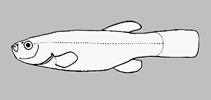
A relatively slender-bodied species, Orestias gloriae is clearly distinguished from all other species of Orestias by the following unique characters: (1) The lyre-shaped pattern of dorsal neuromasts, which is characteristics of Orestias is reduced to the rostral and anterior supraorbital lines formed by small neuromasts followed caudally by few and large isolated neuromasts, which are irregularly placed. (2) The infraorbital line of neuromasts is represented by a discontinuous series of few small neuromasts. (3) The supraorbital line of neuromasts is not connected with both the infraorbital and preopercle-mandibular lines. (4) The skull roof is covered by thick, irregularly-shaped cycloid scales some of which bear marked ridges, whereas other lack ornamentation. (5) The large, irregularly-shaped scales covering the posterior part of the skull roof are ankylosed to each other into a thin, rigid plate. In addition, O. gloriae presents a protractile upper jaw reaching one-third of the head length when extended. This value is higher than those found in other species of Orestias with protactibility and inhabiting the southern Chilean Altiplano. The new species has 29-31 vertebrae, a value that represents the lowest range among species of Orestias (Ref. 89071).
Lebenszyklus und Paarungsverhalten
Geschlechtsreife | Fortpflanzung | Ablaichen | Eier | Fruchtbarkeit | Larven
Vila, I., S. Scott, M.A. Mendez, F. Valenzuela, P. Iturra and E. Poulin, 2012. Orestias gloriae, a new species of cyprinodontid fish from saltpan spring of thesouthern high Andes (Teleostei: Cyprinodontidae). Ichthyol. Explor. Freshwat. 22(4):345-353. (Ref. 89071)
IUCN Rote Liste Status (Ref. 130435: Version 2025-2 (Global))
Bedrohung für Menschen
Harmless
Nutzung durch Menschen
Tools
Zusatzinformationen
Download XML
Internet Quellen
Schätzungen auf der Grundlage von Modellen
Phylogenetischer Diversitätsindex (Ref.
82804): PD
50 = 0.5000 [Uniqueness, from 0.5 = low to 2.0 = high].
Bayesian length-weight: a=0.00389 (0.00180 - 0.00842), b=3.12 (2.94 - 3.30), in cm total length, based on all LWR estimates for this body shape (Ref.
93245).
Trophische Ebene (Ref.
69278): 3.1 ±0.4 se; based on size and trophs of closest relatives
Anfälligkeit der Fischerei (Ref.
59153): Low vulnerability (10 of 100).
🛈