Klassifizierung / Names
Namen | Synonyme | Catalog of Fishes(Gattung, Arten) | ITIS | CoL | WoRMS | Cloffa
>
Beloniformes (Needle fishes) >
Adrianichthyidae (Ricefishes) > Oryziinae
Etymology: Oryzias: Greek, oryza = rice; because of the habitat used by this fish (Ref. 45335); sakaizumii: Named for Dr. Mitsuru Sakaizumi, a molecular geneticist at Niigata University, who pioneered in and contributed to the field of molecular phylogenetic study of Japanese ricefishes.
Eponymy: Dr Mitsuru Sakaizumi is a zoologist and molecular geneticist who heads a lab in the Faculty of Science, Niigata University, Japan. [...] (Ref. 128868), visit book page.
Umwelt: Milieu / Klimazone / Tiefenbereich / Verbreitungsgebiet
Ökologie
; süßwasser pelagisch. Tropical; 36°N - 35°N, 136°E - 137°E
Asia: freshwaters along the Sea of Japan coast in the northern half of Honshu, from the Pacific coast of Momoishi, Aomori Pref. to Hyogo Pref. around Tango, Tajima district that distributional western limit is Hamasaka.
Größe / Gewicht / Alter
Geschlechtsreife: Lm ? range ? - ? cm
Max length : 3.7 cm SL Männchen/unbestimmt; (Ref. 89067)
Kurzbeschreibung
Bestimmungsschlüssel | Morphologie | Morphometrie
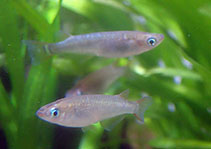
Oryzias sakaizumii is distinguished from all other congeners including O. latipes that are distributed throughout east Asia by the following combination of characters: distribution of melanophores, dense network of melanophores along each scale margin on the body surface in both sexes; depth of notch in membrane between dorsal-fin rays 5 and 6 less than half the length of rays in males; distinctive irregular black spots on the posterior portion of body lateral; and several silvery scales in patches on the posterior portion of the body (Ref. 89067).
Body shape (shape guide): elongated.
Occurs in ponds, marshes, and streams, such as irrigation canals amid paddy fields in flat alluvial lowlands. Well adapted to aquatic life on temporary floodplain wetlands (Ref. 89067).
Lebenszyklus und Paarungsverhalten
Geschlechtsreife | Fortpflanzung | Ablaichen | Eier | Fruchtbarkeit | Larven
Asai, T., H. Senou and K. Hosoya, 2012. Oryzias sakaizumii, a new ricefish from northern Japan (Teleostei: Adrianichthyidae). Ichthyol. Explor. Freshwat. 22(4):289-299. (Ref. 89067)
IUCN Rote Liste Status (Ref. 130435: Version 2025-2 (Global))
Bedrohung für Menschen
Harmless
Nutzung durch Menschen
Fischereien: nicht kommerziell
Tools
Zusatzinformationen
Download XML
Internet Quellen
Schätzungen auf der Grundlage von Modellen
Phylogenetischer Diversitätsindex (Ref.
82804): PD
50 = 0.5000 [Uniqueness, from 0.5 = low to 2.0 = high].
Bayesian length-weight: a=0.00479 (0.00190 - 0.01207), b=3.13 (2.91 - 3.35), in cm total length, based on LWR estimates for this (Sub)family-body shape (Ref.
93245).
Trophische Ebene (Ref.
69278): 3.4 ±0.4 se; based on size and trophs of closest relatives
Anfälligkeit der Fischerei (Ref.
59153): Low vulnerability (10 of 100).
🛈