Klassifizierung / Names
Namen | Synonyme | Catalog of Fishes(Gattung, Arten) | ITIS | CoL | WoRMS | Cloffa
>
Blenniiformes (Blennies) >
Tripterygiidae (Triplefin blennies) > Tripterygiinae
Etymology: Enneapterygius: Greek, ennea = nine times + Greek, pterygion = little fin (Ref. 45335); qirmiz: Name from the Arabic word "Qirmiz" for deep red or crimson, referring to the colour of the species; noun in apposition.
Umwelt: Milieu / Klimazone / Tiefenbereich / Verbreitungsgebiet
Ökologie
seewasser demersal; tiefenbereich 0 - 9 m (Ref. 88983). Tropical; 27°N - 13°N, 36°E - 43°E
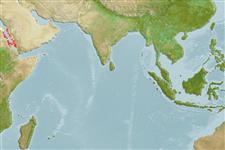
Western Indian Ocean: Red Sea, Gulf of Aqaba, at Ras Mohammad and Ethiopia and off Yemen; the species is widespread, though not common in the Red Sea.
Größe / Gewicht / Alter
Geschlechtsreife: Lm ? range ? - ? cm
Max length : 1.7 cm SL Männchen/unbestimmt; (Ref. 88983)
Kurzbeschreibung
Bestimmungsschlüssel | Morphologie | Morphometrie
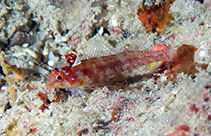
Rückenflossenstacheln (insgesamt) : 15 - 16; Rückenflossenweichstrahlen (insgesamt) : 9; Afterflossenstacheln: 1; Afterflossenweichstrahlen: 17 - 18; Wirbelzahl: 33 - 34. This species is distinguished by the following characters: small sized with a maximum recorded SL of 25.3 mm; D1 III, D2 XII-XIII, D3 9, first dorsal fin about the same height as the second; A I,17; pectoral fin 14; nape scaled; both sexes with characteristic oval patch of melanophores on dorsum between third and fourth dorsal-fin spines, males with large rectangular blotch of melanophores and brown pigment on side below posterior of second dorsal fin; red in life, with first dorsal of males crimson in front with golden yellow marks, white behind, base of fin a white patch on dorsum (Ref. 88983).
Cross section: oval.
Adults are found in environments very similar to E. obscurus. They also commonly occur in isolated reefs far from coasts wherein other Enneapterygius spp. could not be found (Ref. 88983). Eggs are hemispherical and covered with numerous sticky threads that anchor them in the algae on the nesting sites (Ref. 240). Larvae are planktonic which occur primarily in shallow, nearshore waters (Ref. 94114).
Lebenszyklus und Paarungsverhalten
Geschlechtsreife | Fortpflanzung | Ablaichen | Eier | Fruchtbarkeit | Larven
Holleman, W. and S.V. Bogorodsky, 2012. A review of the blennioid fish family Tripterygiidae (Perciformes) in the Red Sea, with description of Enneapterygius qirmiz, and reinstatement of Enneapterygius altipinnis Clark, 1980. Zootaxa 3152:36-60. (Ref. 88983)
IUCN Rote Liste Status (Ref. 130435: Version 2025-2 (Global))
Bedrohung für Menschen
Harmless
Nutzung durch Menschen
Fischereien: nicht kommerziell
Tools
Zusatzinformationen
Download XML
Internet Quellen
Schätzungen auf der Grundlage von Modellen
Bevorzugte Temperatur (Ref.
123201): 27.8 - 29.3, mean 29 °C (based on 91 cells).
Phylogenetischer Diversitätsindex (Ref.
82804): PD
50 = 0.5000 [Uniqueness, from 0.5 = low to 2.0 = high].
Bayesian length-weight: a=0.00617 (0.00290 - 0.01310), b=3.04 (2.86 - 3.22), in cm total length, based on LWR estimates for this (Sub)family-body shape (Ref.
93245).
Trophische Ebene (Ref.
69278): 3.0 ±0.3 se; based on size and trophs of closest relatives
Anfälligkeit der Fischerei (Ref.
59153): Low vulnerability (10 of 100).
🛈