Classificazione / Nomi
Nomi Comuni | Sinonimi | Catalog of Fishes(Genere, Specie) | ITIS | CoL | WoRMS | Cloffa
>
Siluriformes (Catfishes) >
Pseudopimelodidae (Bumblebee catfishes, dwarf marbled catfishes) > Batrochoglaninae
Etymology: Microglanis: Greek, mikros = small + Greek, glanis = a fish that can eat the bait without touching the hook; a cat fish (Ref. 45335); xylographicus: The name xylographicus is derived from the Greek xylosgraphikos, of writing. It is a reference to the horizontally striated color pattern, like a tree bark. An adjective (Ref. 88956).
Ambiente: milieu / zona climatica / distribuzione batimetrica / gamma di distribuzione
Ecologia
; acqua dolce benthopelagico. Tropical; 15°S - 16°S, 52°W - 53°W
South America: Brazil. Known from tributaries of the rio das Mortes and small nearby direct tributaries of the rio Araguaia such as the córrego Jaraguá and rio das Garças, in States of Mato Grosso and Goiás, Brazil (Ref. 88956).
Dimensione / Peso / Età
Maturità: Lm ? range ? - ? cm
Max length : 2.8 cm SL maschio/sesso non determinato; (Ref. 88956)
Breve descrizione
Chiavi di identificazione | Morfologia | Morfometria
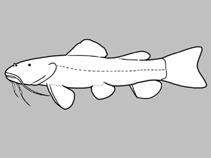
Microglanis xylographicus is easily distinguished from its congeners by two characters related to color pattern: (1) trunk brown with horizontal light stripes that in conjunction impart a tree-bark pattern, and (2) absence of any light marks (blotch or transversal band) crossing the occipital region. The new species can be further distinguished from its congeners, except Microglanis robustus, by the neuromasts surrounded by melanophores, forming three series of aligned small black points laterally on the trunk, four series in the head, one series on the lateral of nape, and one series posterior to the nape. It is distinguished from M. robustus by having a relatively long snout 11.4-12.9% SL (vs. 9.1-10.7% SL), and five pleural ribs (vs. 6 or 7) (Ref. 88956).
Body shape (shape guide): elongated.
Ciclo vitale e comportamento di accoppiamento
Maturità | Riproduzione | Deposizione | Uova | Fecondità | Larve
Ruiz, W.B.G. and O.A. Shibatta, 2011. Two new species of Microglanis (Siluriformes: Pseudopimelodidae) from the upper-middle rio Araguaia basin, Central Brazil. Neotrop. Ichthyol. 9(4):697-707. (Ref. 88956)
Stato della Lista Rossa IUCN (Ref. 130435: Version 2025-2 (Global))
Minaccia per l'uomo
Harmless
Usi umani
Strumenti
Rapporti speciali
Scarica XML
Fonti Internet
Stime basate su modelli
Indice di diversità filogenetica (Fonte Biblio.
82804): PD
50 = 0.5000 [Uniqueness, from 0.5 = low to 2.0 = high].
Bayesian length-weight: a=0.00692 (0.00292 - 0.01638), b=3.12 (2.91 - 3.33), in cm total length, based on LWR estimates for this (Sub)family-body shape (Ref.
93245).
Livello trofico (Fonte Biblio.
69278): 3.2 ±0.4 se; based on size and trophs of closest relatives
Vulnerabilità della pesca (Ref.
59153): Low vulnerability (10 of 100).
🛈