Classification / Noms
Noms communs | Synonymes | Catalog of Fishes(Genre, Espèce) | ITIS | CoL | WoRMS | Cloffa
>
Siluriformes (Catfishes) >
Heptapteridae (Three-barbeled catfishes)
Etymology: Imparfinis: Latin, impar = unequal + Greek, finis, pinna = wing, fin (Ref. 45335); usmai: Dedicated to Saulo Usma for his contributions to
the ichthyological collection building in the Cauca valley, and for promoting an active interchange between Colombian and Venezuelan ichthyologists, since his MSc studies in 2000 at Universidad Nacional Experimental de los Llanos Ezequiel Zamora (Guanare, Venezuela) (Ref. 88952).
Eponymy: José Saulo Usma Oviedo is a Freshwater Specialist at WWF Colombia. [...] (Ref. 128868), visit book page.
Environnement : milieu / zone climatique / profondeur / gamme de distribution
Écologie
; eau douce benthopélagique. Tropical
South America: Colombia. Distributed along the
upper basin of río Cauca and río Magdalena, and in the lower río Patía basin on the Pacific slope of western cordillera of Colombia. Imparfinis usmai is sympatric with I. nemacheir in the río Magdalena.
Taille / Poids / Âge
Maturité: Lm ? range ? - ? cm
Max length : 10.3 cm mâle / non sexé; (Ref. 88952)
Description synthétique
Clés d'identification | Morphologie | Morphométrie
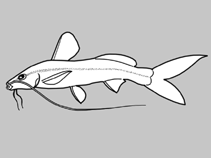
Small heptapterid catfish (largest specimen 100.8 mm SL), with elongated body, triangular in cross-section at dorsal-fin origin, progressively more laterally compressed to tail region. Dorsal profile slightly convex from snout tip to dorsal-fin origin, slightly concave just posterior to dorsal-fin base to adiposefin origin, straight and descending along adipose-fin base, then ascending along caudal peduncle. Ventral profile of head straight, slightly convex along abdomen, then straight to analfin origin and slightly descending along caudal peduncle (Ref. 88952).
Body shape (shape guide): fusiform / normal.
Cycle de vie et comportement reproducteur
Maturité | Reproduction | Frai | Œufs | Fécondité | Larves
Ortega-Lara, A., N. Milani, C. DoNascimiento, F. Villa-Navarro and J.M. Maldonado-Ocampo, 2011. Two new trans-Andean species of Imparfinis Eigenmann & Norris, 1900 (Siluriformes: Heptapteridae) from Colombia. Neotrop. Ichthyol. 9(4):777-793. (Ref. 88952)
Statut dans la liste rouge de l'IUCN (Ref. 130435: Version 2025-2 (Global))
Menace pour l'homme
Harmless
Utilisations par l'homme
Outils
Articles particuliers
Télécharger en XML
Sources Internet
Estimations basées sur des modèles
Indice de diversité phylogénétique (Réf.
82804): PD
50 = 0.5000 [Uniqueness, from 0.5 = low to 2.0 = high].
Bayesian length-weight: a=0.01122 (0.00514 - 0.02450), b=3.04 (2.87 - 3.21), in cm total length, based on all LWR estimates for this body shape (Ref.
93245).
Niveau trophique (Réf.
69278): 3.1 ±0.5 se; based on size and trophs of closest relatives
Résilience (Réf.
120179): Milieu, temps minimum de doublement de population : 1,4 à 4,4 années (Preliminary K or Fecundity.).
Vulnérabilité de la pêche (Ref.
59153): Low vulnerability (10 of 100).
🛈